
Cercestis mirabilis – Care
Location & Light
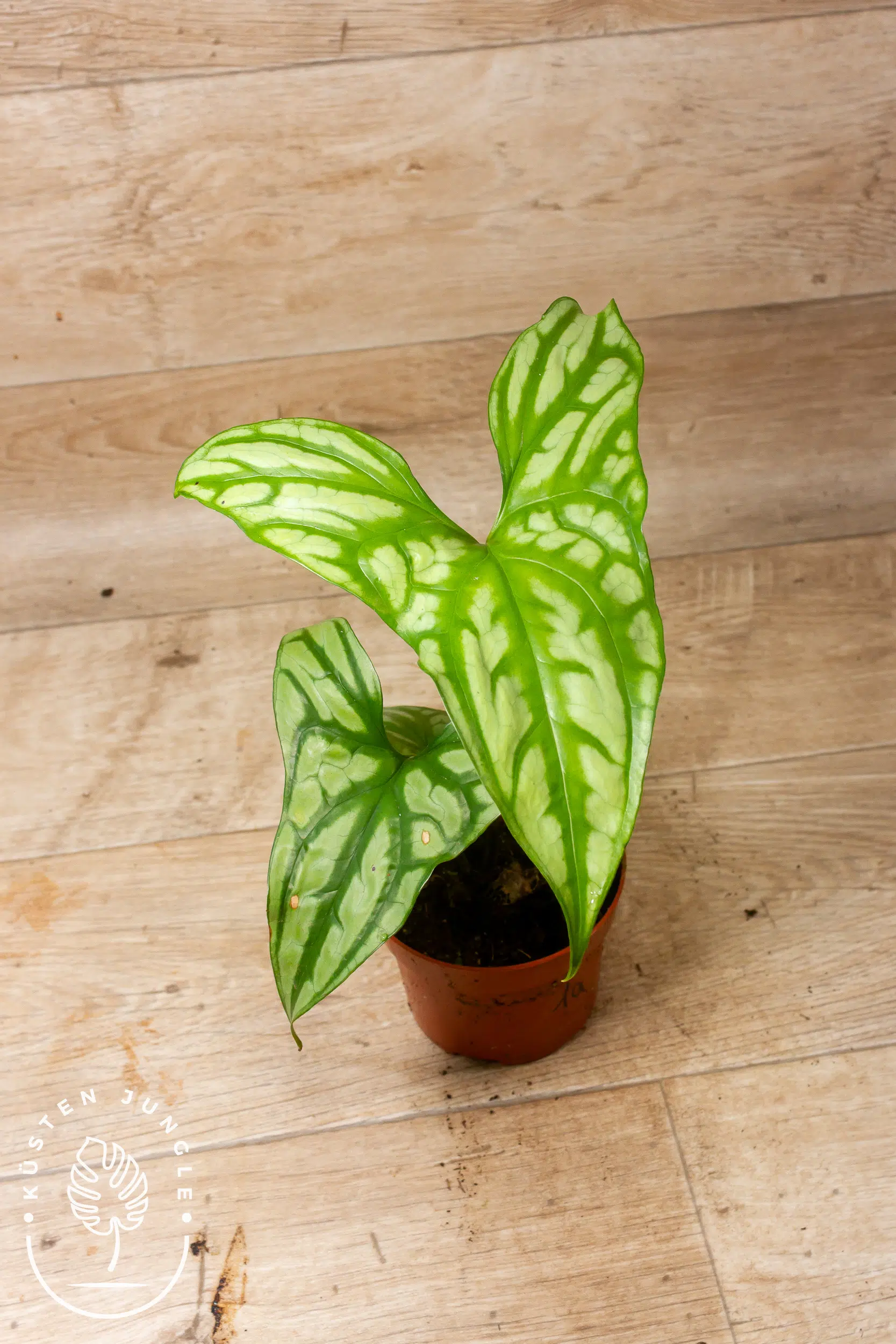
Accustomed to shady forest floors under large trees, this aroid prefers a bright spot with plenty of indirect light in our homes – an east-facing or slightly shaded west-facing window works well. Direct sun quickly scorches the leaves, while placing it in too dark a spot further slows its already leisurely growth and causes the striking silvery pattern on young leaves to appear paler.
Pour
The substrate may dry slightly on the surface but should never dry out completely. This plant thrives best with consistent moisture. In the growing phase, it should be watered more frequently than in winter when its already slow growth is dormant. However, waterlogging in the pot should still be avoided, as the roots are sensitive to prolonged wetness.
Fertilize
Since *Cercestis mirabilis* only produces about 3 to 5 leaves per year, it doesn't require intensive fertilization – a well-diluted liquid fertilizer once a month during the growing season is sufficient. The general guidelines for the genus are a pH of about 5.5 to 6.5 and an electrical conductivity of the irrigation water of roughly 1.0 to 1.5 mS/cm. If the plant is only placed by a window in autumn and winter, less or no fertilization is needed due to the weaker light; however, with year-round bright grow light illumination, fertilization can continue at the usual rhythm.
We consciously alternate between different fertilizers for our own plants – currently including COMPO COMPLETE, Foliage Focus, Liquid Gold Leaf, and Hesi TNT-Complex, supplemented with Hesi Root Complex, Hesi PowerZyme, and CalMag as needed.
Substrate
A light aroid mix of bark, coco coir, some charcoal, and perlite ensures sufficient drainage and prevents waterlogging. A pot with good drainage is important, but repotting is only necessary about every 2 to 3 years due to slow growth.
Humidity & Temperature
This plant thrives in normal room air and typical room temperatures, but permanently very dry air can cause brown spots on the leaves. Slightly increased humidity will noticeably promote more vigorous growth; a humidifier or placing it with other plants can further help with this. Cool drafts should generally be avoided.
Growth & Support
In nature, Cercestis mirabilis climbs tree trunks to considerable heights, but as a houseplant, it grows on a moss pole primarily in one way: very slowly, with only 3 to 5 new leaves per year. The young leaves show a striking silvery, embossed-looking pattern that disappears with age, eventually giving way to uniformly dark green foliage; in older plants, this can even occasionally develop small fenestrations similar to a young Monstera. With window-only placement in autumn and winter, growth slows down even further due to the weaker light; however, with year-round bright grow light illumination, the already leisurely growth remains more consistent.
Good to know
The genus name Cercestis is likely derived from the Greek word for „weaver's shuttle,“ an allusion to the shape of the young leaves, while the species name mirabilis simply means „wonderful.“ Their native habitat is the humid lowland rainforests of West and Central Africa, from Nigeria through the Congo Basin to Uganda and Angola.
Like all aroids, this plant contains calcium oxalate crystals and is irritating to pets and children if ingested – best to place it out of reach.