
Anthurium ‚Michelle‘ by DocBlock – Care
Location & Light
A bright spot with plenty of indirect light is important for this hybrid – without sufficient light, it will shed leaves rather than just grow more slowly. A spot near a window, but without direct sun, is best; the velvety leaf surface burns quickly in direct sunlight. For velvety-leaved anthuriums like this, significantly lower values than for many other houseplants are considered guidelines, around 20 to 100 µmol/m²/s PAR (PPFD), which corresponds to a DLI of approximately 1 to 4 mol/m²/day.
Pour
The top 2 to 3 cm of the substrate may dry out, but it should not dry out completely – this hybrid is more sensitive to overly dry substrate than many other anthuriums. It also doesn't tolerate waterlogging, so excess water in the saucer should always be poured off to prevent root rot.
Fertilize
Due to its rapid growth, this hybrid consumes nutrients in the substrate relatively quickly. A well-diluted liquid fertilizer about once a month during the growth phase is sufficient to replenish them. Guidelines for the genus include a pH value of approximately 5.5 to 6.5 and an electrical conductivity of the irrigation water of roughly 1.0 to 1.5 mS/cm. If the plant is only placed by a window in autumn and winter, it is fertilized less frequently or not at all due to the weaker light; however, with year-round bright plant lamp lighting, fertilization can continue at the usual rhythm.
We consciously alternate between different fertilizers for our own plants – currently including COMPO COMPLETE, Foliage Focus, Liquid Gold Leaf, and Hesi TNT-Complex, supplemented with Hesi Root Complex, Hesi PowerZyme, and CalMag as needed.
Substrate
A coarse, well-draining mix of orchid bark, perlite, and some compost or coco coir will retain enough moisture without suffocating the roots. A pot with good drainage is important; repotting is usually done once a year or as soon as the plant has doubled in size.
Humidity & Temperature
Ideal humidity levels range between 60 and 80 %, but this hybrid can also tolerate normal indoor air humidity, though it will grow somewhat more slowly under those conditions. It’s best to avoid misting, as the effect is short-lived and standing moisture on the velvety leaves can promote fungal growth—a humidifier or good air circulation are the more reliable options here. The ideal temperature range is between 18 and 27 °C; drafts and sudden temperature changes should be avoided.
Growth & Form
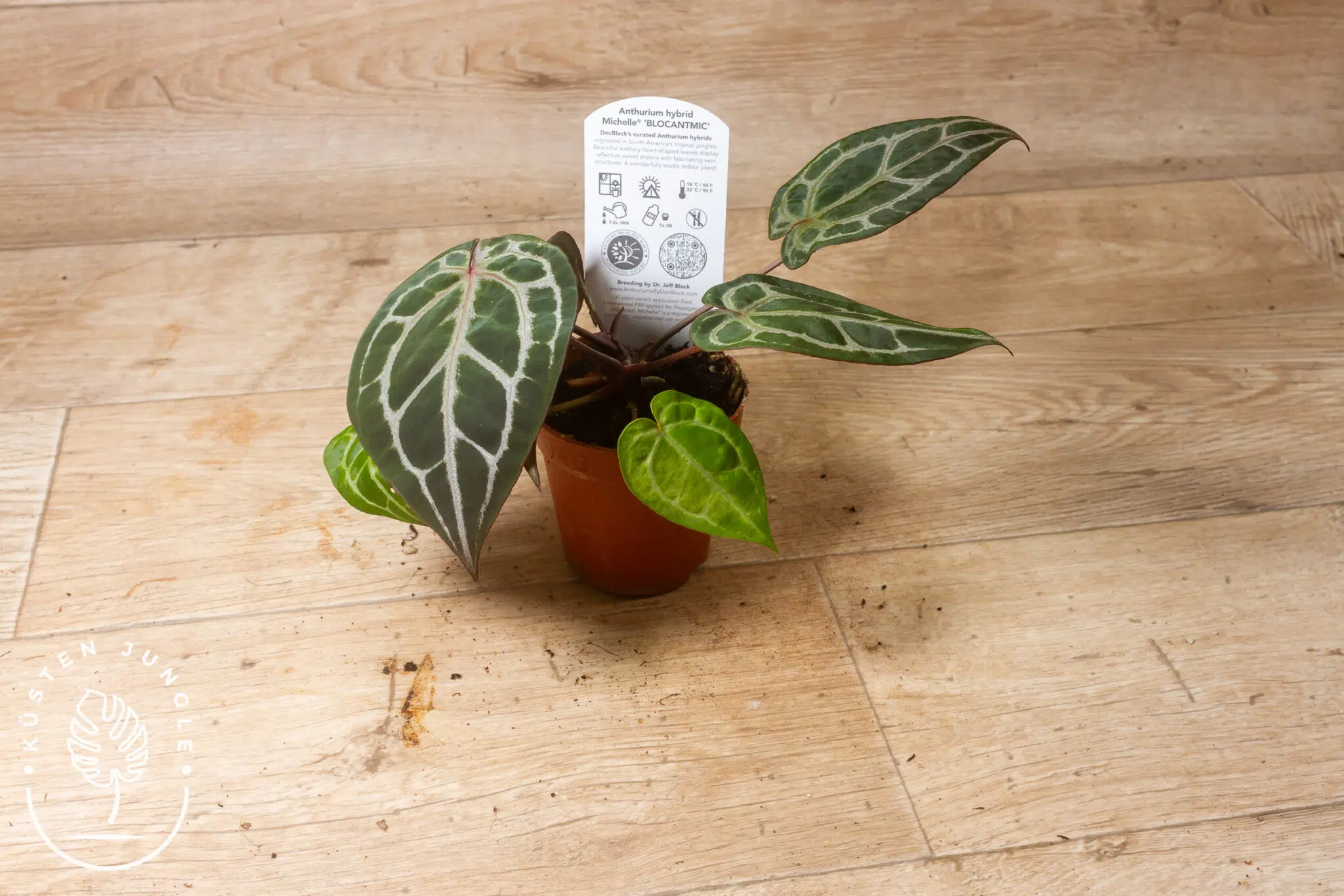
As a self-heading rosette plant, ‚Michelle‘ grows upright without climbing ambitions, reaching a height of about 60 to 90 cm (2 to 3 feet) and a similar width as a houseplant. The real spectacle is the leaf color: young leaves emerge in a strong burgundy to purple with reddish veins, transforming through bronze and dark violet tones to a rich, velvety dark green with contrasting white veins, while the underside of the leaves lightens from a strong lavender to a pale green. With window-only cultivation in autumn and winter, growth perceptibly slows due to weaker light; however, with year-round bright plant lamp illumination, growth remains largely consistent.
Good to know
‚Michelle‘ traces back to a Colombian selection of *Anthurium magnificum* that American *Anthurium* breeder Dr. Jeff Block – known as „DocBlock“ – first distributed through the Daisy Farm nursery in the late 1980s and named after his wife. In 2022, it was awarded „Best New Flowering Plant“ at the Tropical Plant International Expo.
Like all aroids, this Anthurium also contains calcium oxalate crystals and is irritating to pets and children if ingested – best to place out of reach.