
Ficus sagittata ‚Pink Variegata‘ - Care
Location & Light
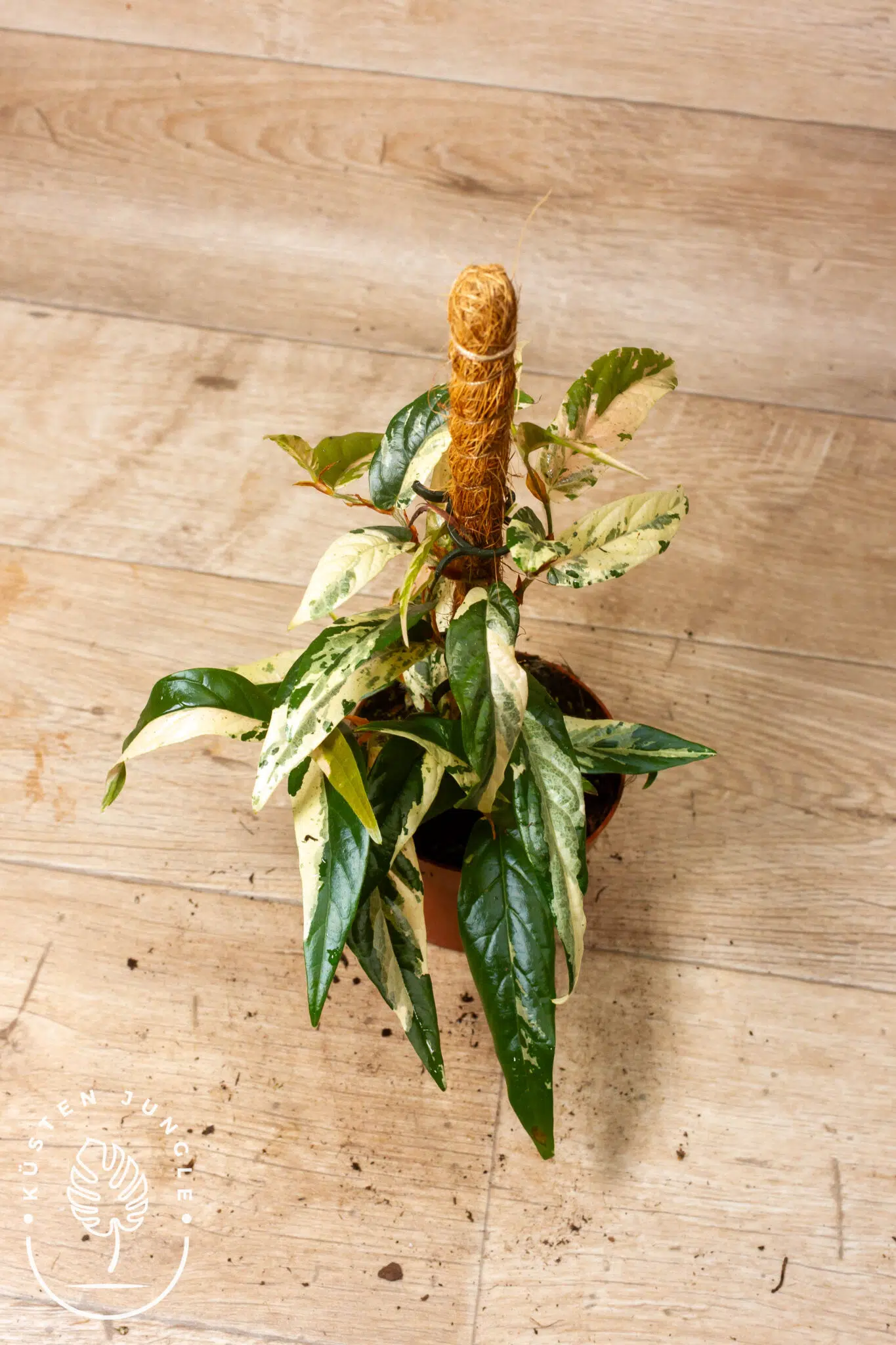
The more bright, indirect light this variety receives, the stronger the pink hue in its leaves will be – an east or west window is ideal, but it works just as well under a grow light. Direct sun, on the other hand, quickly dries out the delicate leaves, and if placed in too dark a spot, the pink color will fade almost completely in favor of pure green.
Pour
The top layer of the substrate may dry out slightly between waterings, but the substrate should never dry out completely for this variety –.
Fertilize
During the growth phase from spring to summer, a well-diluted liquid fertilizer every 3 to 4 weeks is sufficient; fertilization is stopped in autumn and winter. For the genus, pH values of approximately 6.0 to 6.5 and an electrical conductivity of the irrigation water of roughly 1.0 to 2.0 mS/cm are considered benchmarks. If the plant is only placed by the window in autumn and winter, no further fertilization is necessary due to the weaker light. However, with year-round bright plant lamp lighting, fertilization can continue at the usual rhythm.
We consciously alternate between different fertilizers for our own plants – currently including COMPO COMPLETE, Foliage Focus, Liquid Gold Leaf, and Hesi TNT-Complex, supplemented with Hesi Root Complex, Hesi PowerZyme, and CalMag as needed.
Substrate
A permeable, nutrient-rich substrate of potting soil with some perlite or vermiculite ensures the right balance between moisture retention and drainage. A pot with sufficient drainage holes is important; repotting is usually done every one to two years in the spring.
Humidity & Temperature
This variety feels particularly at home in a humid terrarium or bottle garden, but with otherwise stable care, it will also do well as a common houseplant. Instead of regular spraying – the effect quickly disappears and persistently wet leaves can encourage rot – a humidifier nearby ensures more consistent results. The temperature should not consistently drop below approximately 16 °C; stable conditions are tolerated much better than fluctuations.
Growth & Support
With fine aerial roots along its flexible shoots, this Ficus species climbs up rough surfaces like bark or moss, but can just as easily be cultivated as a hanging basket plant. Its growth is pleasingly rapid, making regular pruning advisable to keep its shape compact. When kept solely by a window in autumn and winter, growth noticeably slows due to weaker light; however, with year-round bright plant lamp illumination, growth remains largely consistent.
Good to know
Ficus sagittata is a creeping or climbing fig species native to southern China, Indochina, and the Malay Archipelago, where it grows on the ground or on tree trunks. ‚Pink Variegata‘ is a cultivated color form with the characteristic tender pink variegation, the intensity of which depends heavily on the light available.
Like other Ficus species, this variety contains a milky plant sap that can cause mild irritation to sensitive skin; if ingested by pets or children, it can cause mild discomfort, so it should be kept out of reach.