
Geogenanthus ciliatus ‚Aura Flame‘ – Care
Location & Light
As a resident of the rainforest floor, this plant needs surprisingly little light – a shady to semi-shady spot is perfectly adequate, as direct sun quickly scorches the delicate leaves. Unlike most variegated plants, less light here enhances the colors rather than diminishing them: the bluish-purple tones remain more stable and intense in shadier conditions, while too much brightness tends to make the pattern fade. It is therefore a good choice for darker corners of the home where other plants tend to struggle.
Pour
The substrate should be kept consistently moist and should never dry out completely. It's best to check regularly with your finger and water more often in smaller amounts if needed. However, it does not tolerate waterlogging and reacts with rot, so always drain any excess water. Water at room temperature and low in lime is better tolerated than cold tap water.
Fertilize
During the growth phase, a liquid fertilizer diluted to about a quarter of the recommended amount once a month is sufficient; more would hardly benefit the rather moderate growth. The recommended values are a pH of about 6.5 to 7.0 and an electrical conductivity of the irrigation water of roughly 1.0 to 1.5 mS/cm. If the plant is only on the windowsill in autumn and winter, no further fertilization is needed due to the weaker light anyway; however, with year-round bright plant lamp lighting, fertilization can continue at the normal rhythm for a little longer.
We consciously alternate between different fertilizers for our own plants – currently including COMPO COMPLETE, Foliage Focus, Liquid Gold Leaf, and Hesi TNT-Complex, supplemented with Hesi Root Complex, Hesi PowerZyme, and CalMag as needed.
Substrate
A humus-rich, yet well-draining mixture of leaf mold, peat substitute, and some coarse sand or perlite suits this plant best. Repot only when the root ball is completely established, and even then, only into a slightly larger pot. From about 18 cm pot diameter, older specimens usually look less attractive than fresh plants propagated from cuttings.
Humidity & Temperature
When it comes to humidity, this plant is indeed demanding: levels of at least about 70 % are considered necessary for it to thrive. A closed or semi-open terrarium is therefore much better suited than an open windowsill; if you want to try keeping it there, you’ll likely need a humidifier, since misting only maintains humidity briefly and can even promote fungal growth if moisture remains on the leaves. As for temperature, it prefers a comfortably mild range between 14 and 25 °C; temperatures above 27 °C should be avoided.
Growth & Form
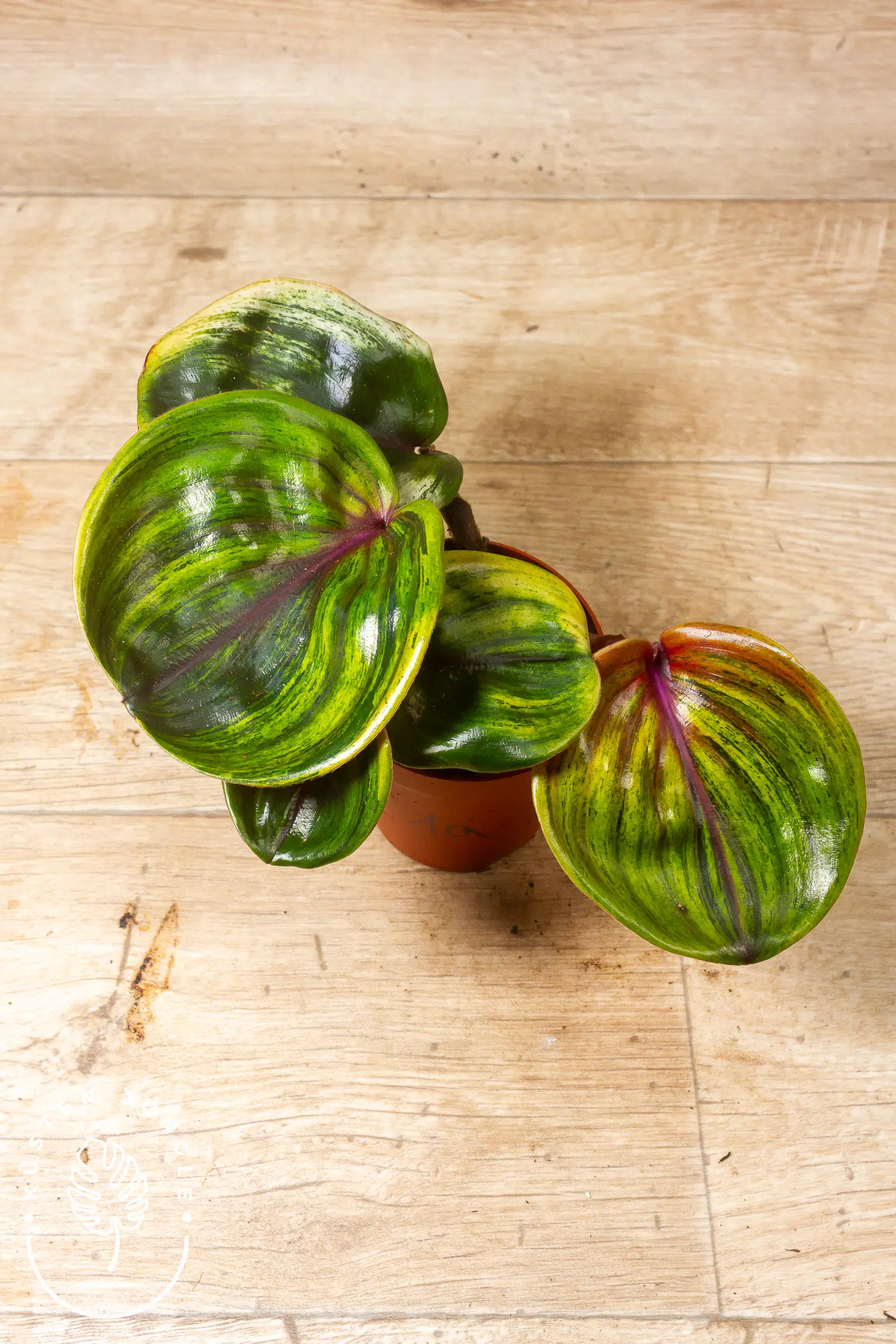
Unlike most related species, this variety typically bears only a single, rounded leaf on its short, fleshy shoot, instead of a whole rosette – occasionally two may form. The shiny upper side displays an interplay of yellow, green, and violet tones, while the underside shimmers velvety dark violet. The growth remains compact and slow overall; under good conditions, small, violet-fringed flowers occasionally appear directly at the base of the shoot, albeit rarely. With purely window-based cultivation in autumn and winter, growth slows down further due to the weaker light; in contrast, growth remains more even under year-round bright grow light illumination.
Good to know
Geogenanthus ciliatus originates from the mid-Andean slopes of Ecuador to the lowlands of northern Peru, where it grows exclusively on the ground in undisturbed rainforests. The genus name is composed of the Greek words for „earth“ and „flower,“ alluding to the fact that the flowers appear close to the ground directly on the shoot; botanically, the genus is closely related to the well-known spiderwort (Tradescantia).
There are no clear indications of dangerous ingredients regarding the toxicity of this plant, as is the case with many aroid plants. However, contact with the plant sap can still cause mild irritation in sensitive individuals.