
Homalomena sulcata ‚Cream Frost‘ – Care
Location & Light
Bright, indirect light is more important for this heavily variegated variety than for purely green Homalomena species, as the white areas of the leaves can hardly photosynthesize and therefore depend on sufficient light. Direct sun will still burn the sensitive leaves quickly; an east or west window with filtered light is a good fit. If placed in too dark a spot, the growth will become noticeably tougher and leggier.
Pour
The substrate should be kept evenly moist, without completely drying out or becoming waterlogged. It is best to check the top 2 to 3 cm with your finger before watering again. Dry substrate causes leaves to yellow quickly, while waterlogging leads to root rot – consistency is more important here than a rigid schedule.
Fertilize
During the growth phase from spring to summer, a well-diluted, balanced liquid fertilizer every 4 to 6 weeks is sufficient. Fertilization should be stopped in autumn and winter. General guidelines for the genus are a pH value of approximately 5.5 to 6.5 and an electrical conductivity of the irrigation water of roughly 1.0 to 2.0 mS/cm. If the plant is placed by a window only during autumn and winter, fertilization will be reduced anyway due to the weaker light. However, with year-round bright artificial lighting, fertilization can continue at the normal rhythm for a bit longer.
We consciously alternate between different fertilizers for our own plants – currently including COMPO COMPLETE, Foliage Focus, Liquid Gold Leaf, and Hesi TNT-Complex, supplemented with Hesi Root Complex, Hesi PowerZyme, and CalMag as needed.
Substrate
A slightly acidic, loose, and well-draining substrate with orchid bark, perlite, and some coco coir provides the right balance of moisture and aeration for the roots. A pot with good drainage is important, as the roots are sensitive to waterlogging.
Humidity & Temperature
This genus is indeed particular about humidity: levels between 60 and 80 % are universally considered necessary; below that, brown leaf edges quickly appear. This is even more true for this variety, which has particularly thin leaves and pronounced variegation, than for purely green Homalomena. A humidifier or a plant display case is much more effective here than simply misting the plant. The ideal temperature range is between 18 and 27 °C; temperatures below about 16 °C and drafts should be avoided.
Growth & Form
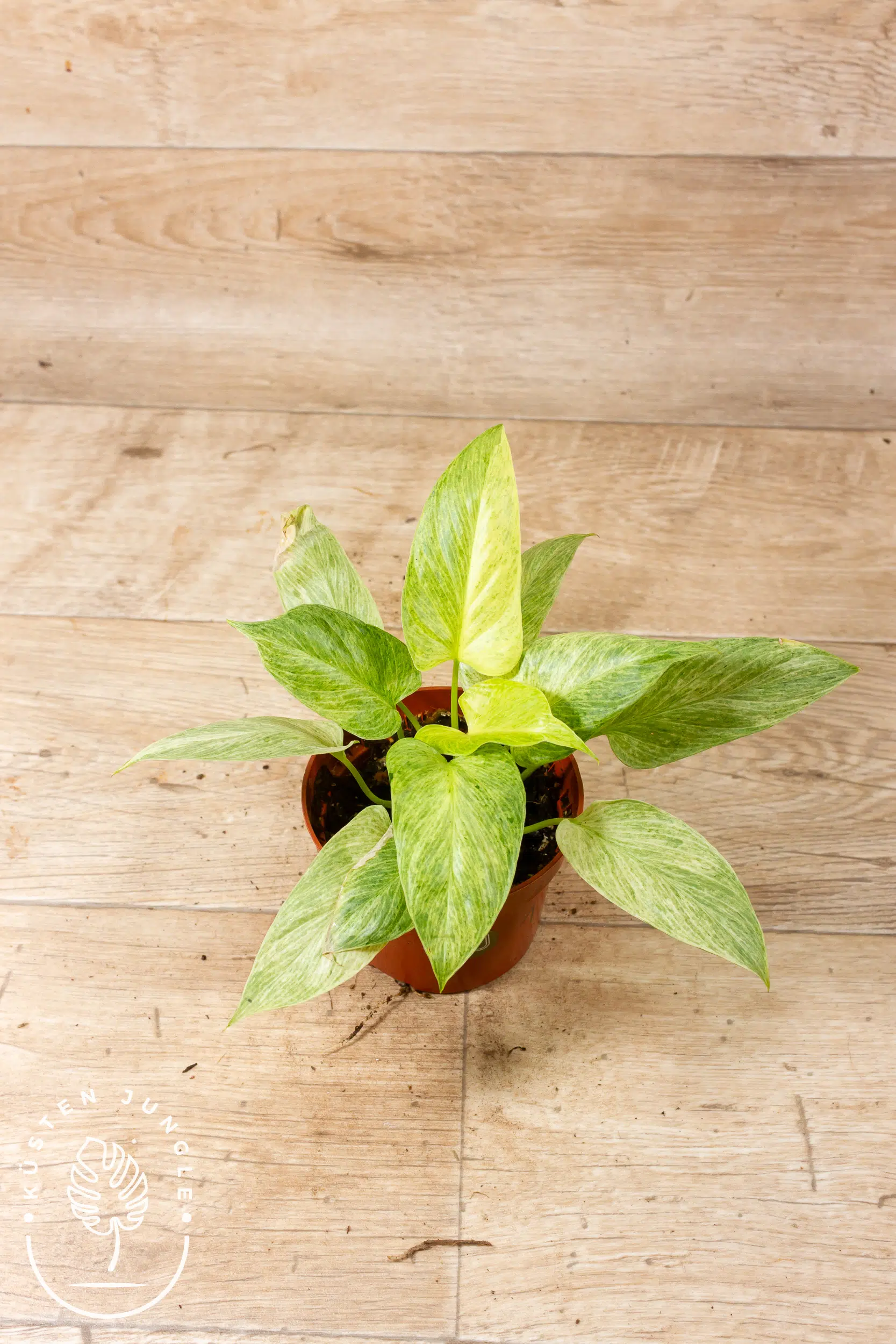
This Homalomena grows compactly and forms clumps instead of climbing, with the characteristic, finely ribbed leaves (Latin „sulcata“ = furrowed). The cream-white variegation with green speckles makes each leaf unique. Due to the very thin, light leaf structure, newly acquired plants may initially show some brown spots – this will resolve on its own with subsequent leaves that grow back unharmed. This species does not require support for climbing. With indoor window placement only, growth noticeably slows down in autumn and winter due to weaker light. However, with year-round bright plant lamp illumination, growth remains largely consistent.
Good to know
The genus Homalomena is native to the humid rainforests of Southeast Asia, with concentrations in Borneo, Sumatra, Malaysia, and the Philippines, and is commonly called the „Queen of Hearts“ due to its mostly heart-shaped leaves. Because of its decorative foliage, the genus has also historically been used in the traditional medicine of some indigenous communities.
Like all aroids, this Homalomena contains calcium oxalate crystals and is irritating if ingested by pets and children – best to place it out of reach.