
Labisia japonica – Care
Location & Light
Accustomed to the forest floor, this Labisia thrives best in medium to bright, but always indirect light – a north or east-facing window is suitable, as direct sun quickly scorches its delicate leaves. If it's kept in too dim conditions, its growth becomes noticeably tougher and the color intensity of the leaves diminishes. As a guideline for indoor cultivation, only about 30 to 60 µmol/m²/s PAR (PPFD) is considered for the genus, which corresponds to a DLI of approximately 1.5 to 2.5 mol/m²/day.
Pour
Watering is done as soon as the top 1 to 2 cm of the substrate have dried out – the goal is evenly moist, not wet. Soft, low-lime water is tolerated much better than hard tap water, which can lead to deposits in the substrate over time. This Labisia cannot tolerate waterlogging at all and quickly reacts to it with root rot, so excess water should always be drained off.
Fertilize
During the growth phase, a well-diluted liquid fertilizer is sufficient every 2 to 4 weeks. In autumn and winter, fertilization is reduced or discontinued. Guidelines for the genus suggest a pH value of approximately 5.5 to 6.5 and an electrical conductivity of the irrigation water of roughly 1.0 to 1.5 mS/cm. If the plant is only placed by the window in autumn and winter, less frequent or no fertilization is done due to the weaker light. However, with continuous lighting from plant lamps year-round, fertilization can continue at the usual rhythm.
We consciously alternate between different fertilizers for our own plants – currently including COMPO COMPLETE, Foliage Focus, Liquid Gold Leaf, and Hesi TNT-Complex, supplemented with Hesi Root Complex, Hesi PowerZyme, and CalMag as needed.
Substrate
A mix of aroid substrate, some sphagnum moss, and perlite will keep the moisture even without suffocating the roots. A pot with good drainage is a must, as this Labisia is sensitive to permanently wet feet.
Humidity & Temperature
Labisia japonica usually thrives in normal indoor air conditions, but brown leaf tips may appear if the air remains very dry for extended periods. At humidity levels of around 60 %, the velvety texture of the leaves becomes much more pronounced; a closed terrarium or a nearby humidifier helps keep the microclimate particularly stable. The ideal temperature range is between 20 and 28 °C.
Growth & Form
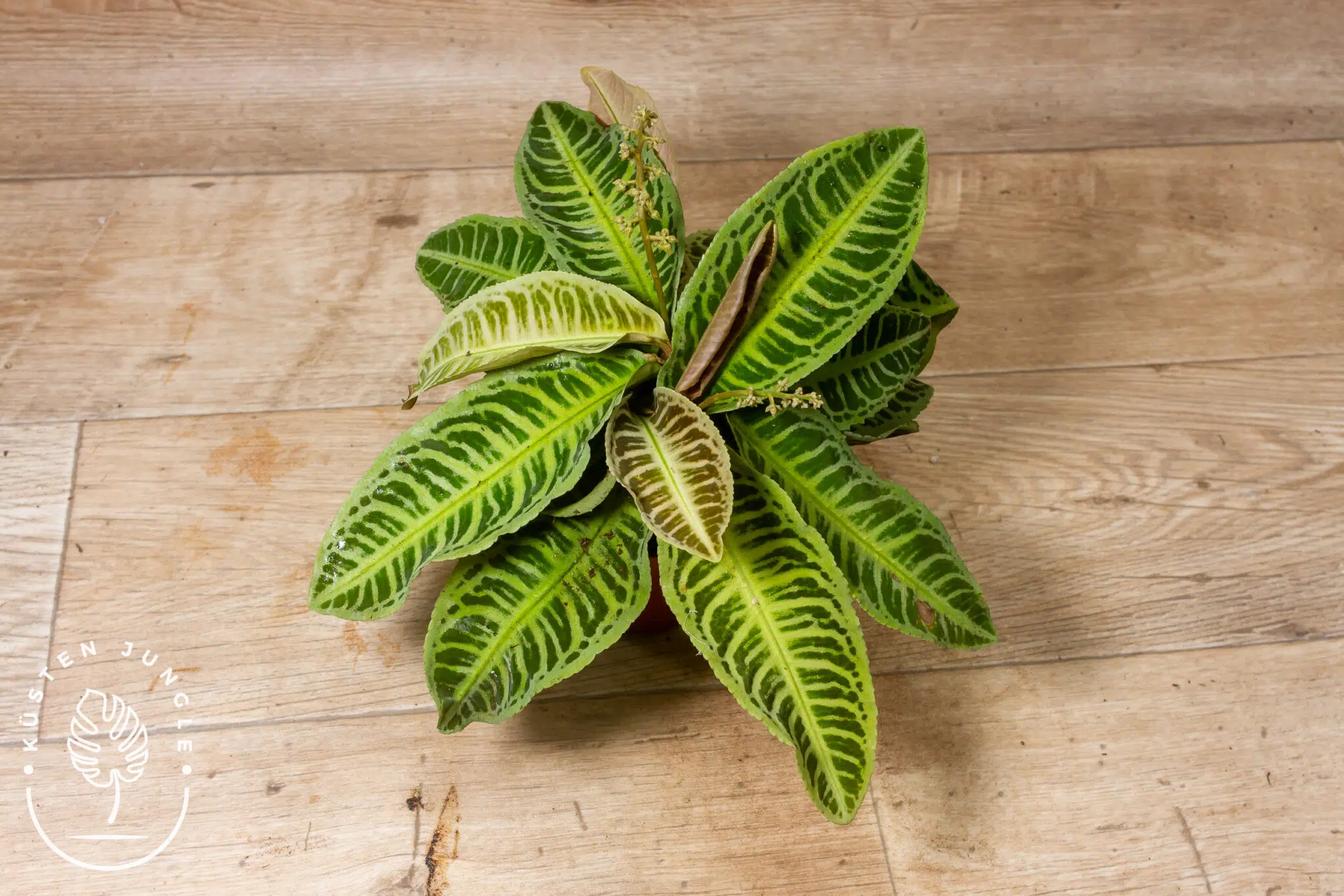
This Labisia stays low and compact and looks decorative even in small pots. The velvety leaf surface with its finely shimmering, silvery veins is the real highlight and looks best under stable, rather consistent conditions. Getting new leaves with this slow to moderately growing species is a reliable sign that the care is right. During autumn and winter, if kept solely on a windowsill, the already leisurely growth slows down further due to the weaker light; however, with year-round bright plant lamp illumination, growth remains more consistent.
Good to know
Labisia japonica is closely related to Labisia pumila, which is also traditionally used as a medicinal plant in Southeast Asia. Plants that look different are circulating in trade under the trade name „Labisia japonica“ – in addition to the velvety dark green form with silvery veining described here, a lighter, lime green-dark green striped form is occasionally offered under the same name. So, it's worth taking a look at the actual plant if yours looks different than expected.
There is currently no reliable data on the pet compatibility of Labisia, so it should be kept out of reach of curious pets as a precaution.