
Labisia sp. ‚Turtle Back‘ - Care
Location & Light
Accustomed to the forest floor of Southeast Asia's shady rainforests, this Labisia prefers a bright to partially shaded spot without direct sun. Intense sunlight will quickly fade the leaf color and can even burn the leaf tips over time, while too much shade will make its already slow growth even more sluggish. For indoor cultivation, guideline values for this genus are only about 30 to 60 µmol/m²/s PAR (PPFD), which corresponds to a DLI of approximately 1.5 to 2.5 mol/m²/day – significantly more shade-tolerant than most other houseplants.
Pour
The substrate should be kept evenly moist, without drying out completely. The best way to check is to feel the top 2 to 3 cm with your finger before watering again. Soft, lukewarm water is tolerated much better than hard, cold tap water. However, you should still avoid waterlogging in the pot, as the roots are sensitive to prolonged wetness.
Fertilize
During the growth phase, a well-diluted liquid fertilizer every 2 to 4 weeks is sufficient; more would hardly benefit the rather slow growth. As guidelines for the genus, a pH value of around 5.5 to 6.5 and an electrical conductivity of the irrigation water of roughly 1.0 to 1.5 mS/cm are considered. If the plant is only on the windowsill in autumn and winter, fertilizing is done less often or not at all due to the weaker light; however, with year-round bright plant lamp lighting, fertilizing can continue at the usual rhythm.
We consciously alternate between different fertilizers for our own plants – currently including COMPO COMPLETE, Foliage Focus, Liquid Gold Leaf, and Hesi TNT-Complex, supplemented with Hesi Root Complex, Hesi PowerZyme, and CalMag as needed.
Substrate
A loose, humus-rich, and well-draining substrate of fine aroid soil, perlite, and some sphagnum moss suits this Labisia best. A pot with good drainage is important, as the fine roots cannot tolerate prolonged wetness.
Humidity & Temperature
When it comes to humidity, this Labisia is indeed demanding: levels between 70 and 90 % are universally considered ideal; below that, growth quickly slows, and the vibrant leaf color loses its intensity. A closed or semi-open terrarium—or a spot in the bathroom—is therefore much better suited than an open windowsill; if you want to try keeping it there, you should definitely use a humidifier or place a tray of water nearby. As for temperature, the optimal range is between 22 and 25 °C; it should not drop below 17 °C for extended periods.
Growth & Form
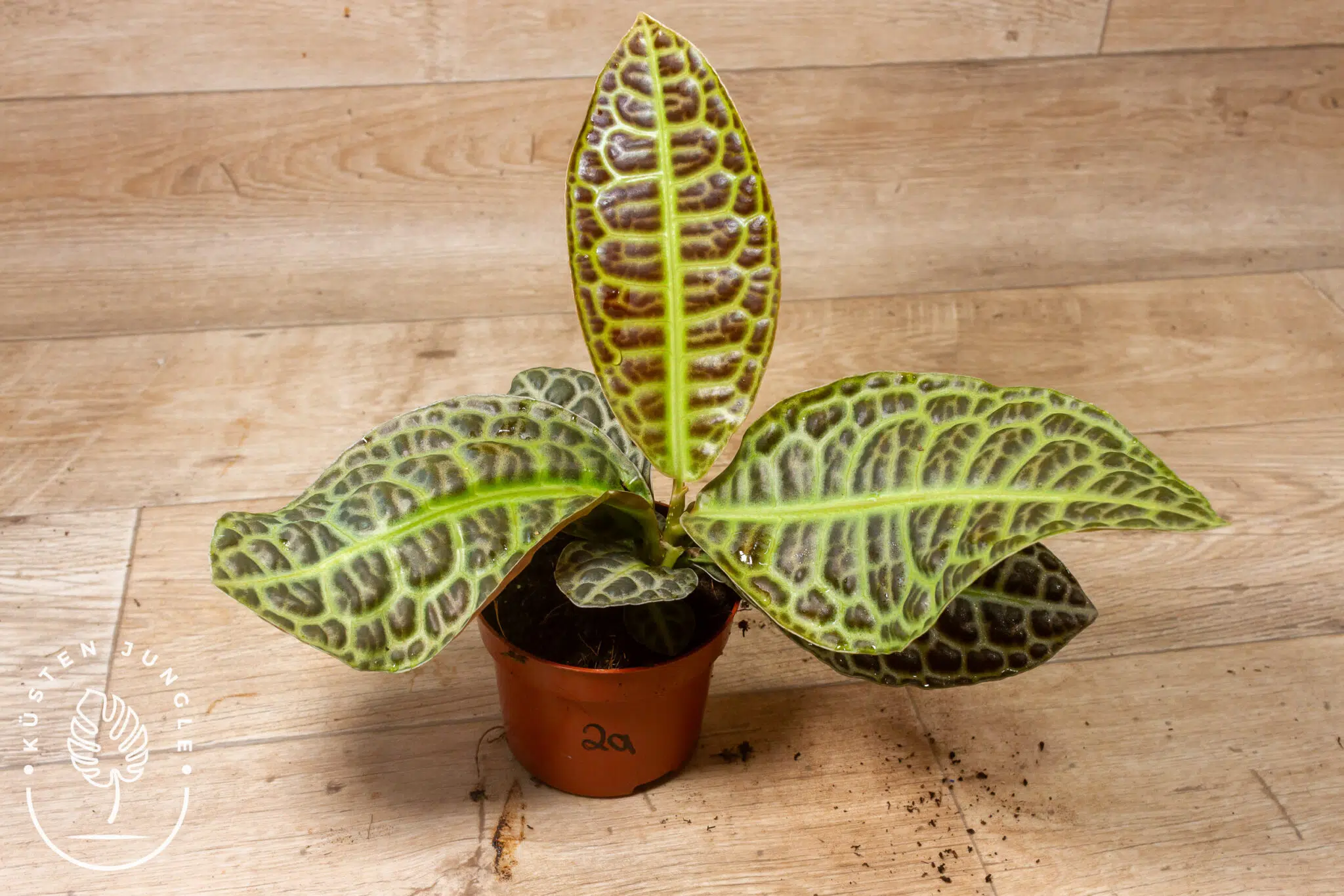
This Labisia grows compactly, forming dense, rosette-like clusters of leaves over time rather than spreading outwards or upwards. Its name comes from the distinctive veining of its oval, leathery leaves, which resemble the structure of a turtle shell. Newly emerged leaves initially appear bright red before darkening to the rich dark green of older leaves. Getting new leaves on this rather slow-growing species is a reliable sign that the care is appropriate. With placement solely near a window in autumn and winter, the already slow growth is further reduced by the weaker light; however, with consistent bright artificial lighting year-round, growth remains more even.
Good to know
The trade name „Turtle Back“ is used for more than one similarly patterned Labisia species; depending on the seller, the plant appears as either Labisia obtusifolia or Labisia beccarii, meaning a definitive botanical classification is not always provided in trade. There is currently no reliable data available on the compatibility of Labisia with pets, which is why it should be kept out of reach of curious pets as a precautionary measure.