
Monstera deliciosa ‚Bulbasaur‘ – Care
Location & Light
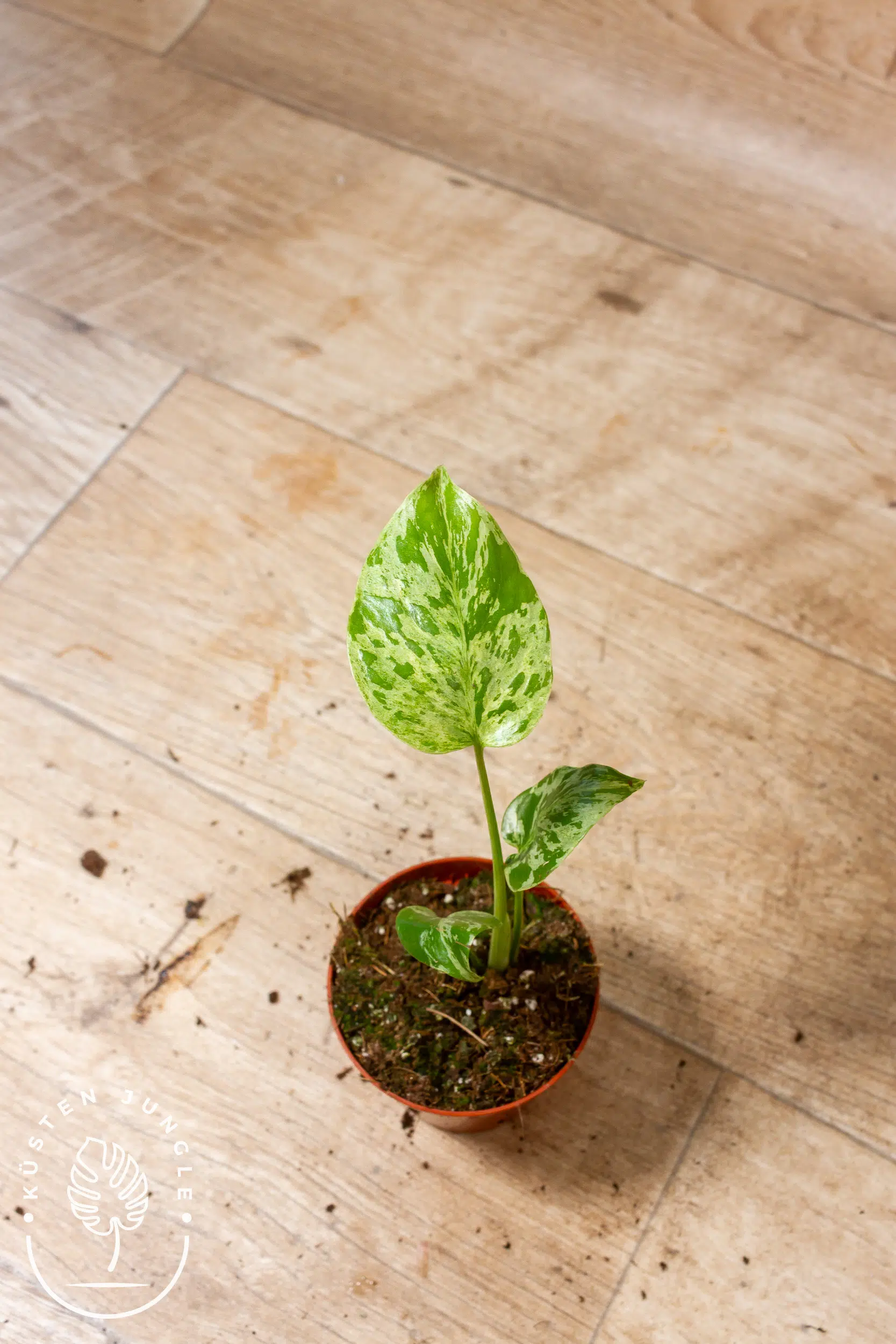
Bright, indirect light best showcases the fine, cream-white speckling of this variety. Too much direct sun quickly burns the lighter, variegated areas of the leaves, while too little light slows growth and causes the variegation to become paler. An east or west window with filtered light is usually a good choice.
Pour
Once the top 2 to 3 cm of the substrate are dry, water thoroughly. Those who wish can also let the substrate dry out almost completely before watering again. Too much moisture is a greater enemy for this variety than some dryness and quickly leads to root rot. Therefore, always pour off excess water in the saucer.
Fertilize
Unlike some fussy variegated Monstera varieties, ‚Bulbasaur‘ remains pleasingly vigorous despite its dense speckling and therefore requires regular care – a well-diluted liquid fertilizer approximately every 2 to 4 weeks during the growing season is sufficient. As guidelines for the genus, a pH of around 6.0 to 6.5 and an electrical conductivity of the irrigation water of roughly 1.0 to 2.0 mS/cm are considered. If the plant is placed only by the window in autumn and winter, no more fertilizing will be done due to the weaker light anyway; however, with year-round bright plant lamp lighting, fertilizing can continue at the usual rhythm.
We consciously alternate between different fertilizers for our own plants – currently including COMPO COMPLETE, Foliage Focus, Liquid Gold Leaf, and Hesi TNT-Complex, supplemented with Hesi Root Complex, Hesi PowerZyme, and CalMag as needed.
Substrate
A coarse, nutrient-rich substrate made of orchid bark, perlite, and some coco coir ensures the right balance between moisture retention and drainage. A pot with sufficient drainage holes is important so that excess water can drain away quickly.
Humidity & Temperature
This Monstera does well in normal indoor air, but at humidity levels of about 60 % or higher, its growth and variegation become noticeably more vigorous. Regular ventilation or a small fan nearby also helps prevent fungal problems, which can develop more quickly in stagnant, humid air. The ideal temperature range is between 18 and 28 °C.
Growth & Support
This variety showed good fenestration from a young age, with the characteristic deep incisions that are meant to resemble the Pokémon of the same name. When trained up a coconut or moss pole, the leaves grow larger and more fenestrated than when grown freely; without support, they tend to remain smaller and the fenestration is less pronounced. With purely window cultivation in autumn and winter, growth noticeably slows due to the weaker light; however, with year-round bright grow light illumination, growth remains largely consistent.
Good to know
‚Bulbasaur‘ is a spontaneous mutation discovered around 2020 among seedlings of the normal green Monstera deliciosa in China. It was initially associated with „Mint“ varieties under a different name, and its exact origin is still debated today. Unlike some fickle variegated Monsteras, the dense, speckled variegation of this variety appears to have little impact on its growth vigor.
Like all aroids, this Monstera also contains calcium oxalate crystals and is irritating for pets and children if ingested – best to place it out of reach.