
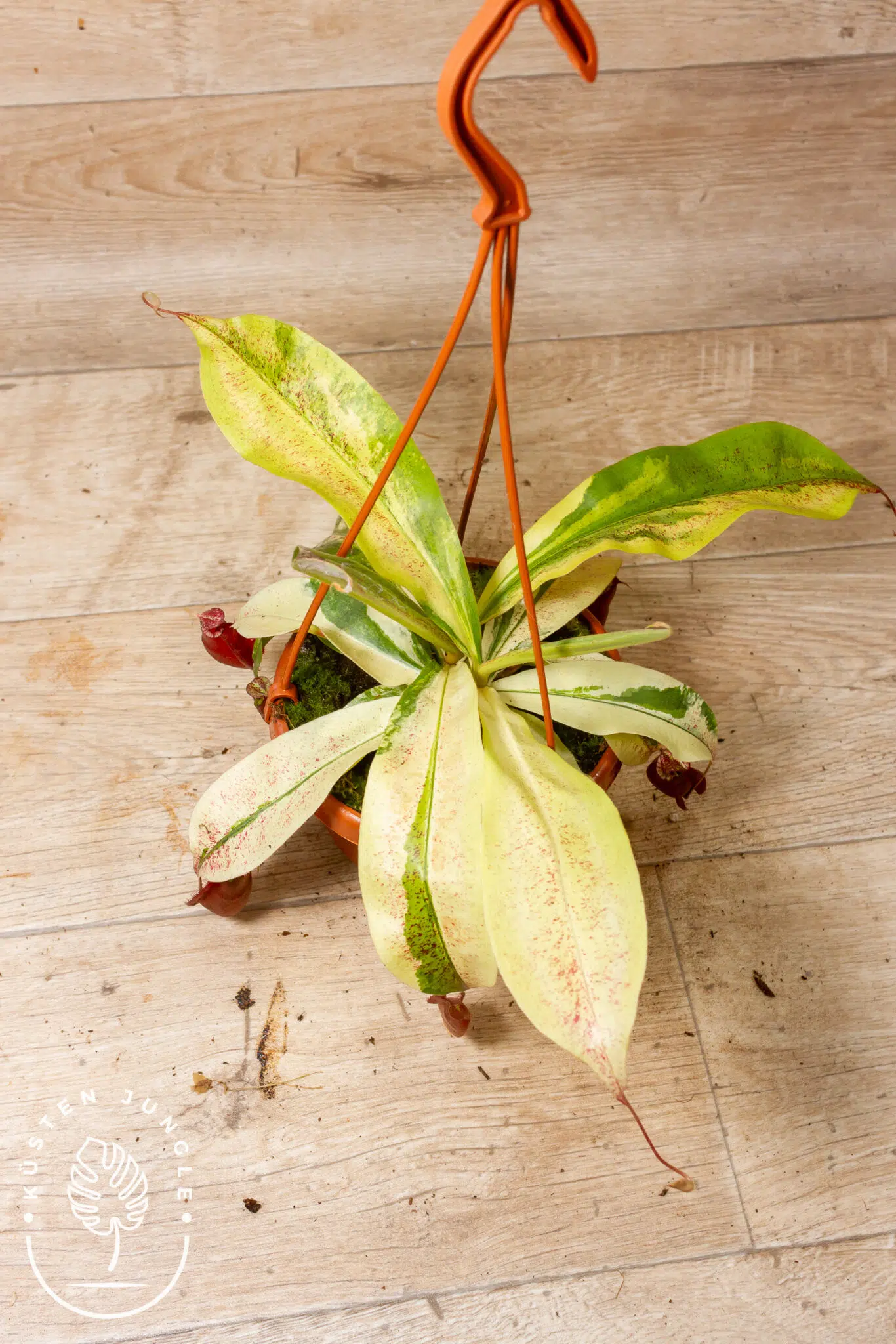
Nepenthes ‚Viking‘ x ampullaria ‚Variegata‘ – Care
Location & Light
A bright spot with plenty of indirect to lightly filtered direct light will allow this pitcher plant to grow most vigorously and encourage it to produce many pitchers – with too little light, it will continue to grow leaves, but hardly any pitchers. As a rough guide, the ideal range is around 100 to 200 µmol/m²/s PAR (PPFD) with a photoperiod of 12 to 14 hours, which corresponds to a DLI of approximately 4 to 10 mol/m²/day. Gentle morning or evening sun is usually well tolerated, whereas direct midday sun behind glass can burn the leaves.
Pour
The substrate should be consistently moist, like a wrung-out sponge – never soaking wet, but never completely dried out. More important than with most other houseplants, pitcher plants require specific water quality: water exclusively with distilled water, rainwater, or water from a reverse osmosis system, as the salt-sensitive roots can react negatively to the minerals in regular tap water. In autumn and winter, when growth slows, water slightly less often, but the substrate should never completely dry out.
Fertilize
Unlike most other houseplants, a pitcher plant is not fertilized through the substrate – conventional liquid or granular fertilizer in the root area can quickly damage the sensitive roots. Instead, the plant primarily feeds on the prey caught in its pitchers: small insects are sufficient for this, and special feeding is usually not necessary. Those who want to give it an extra boost can occasionally (about once a month) drip a tiny amount of heavily diluted, low-mineral liquid fertilizer directly into an already open pitcher during the growing season. In winter, when growth is dormant, no fertilization is done at all.
We consciously alternate between different fertilizers for our own plants – currently including COMPO COMPLETE, Foliage Focus, Liquid Gold Leaf, and Hesi TNT-Complex, supplemented with Hesi Root Complex, Hesi PowerZyme, and CalMag as needed.
Substrate
Normal potting soil is unsuitable for pitcher plants because it is too rich in nutrients and too high in minerals. Instead, this Nepenthes needs a loose, acidic, and nutrient-poor substrate, such as a mixture of sphagnum moss, perlite, and orchid bark in a ratio of approximately 1:2:1. Ensure that none of the ingredients are pre-fertilized. Repotting is done rather infrequently, as the roots do not like disturbances. A change is only worthwhile when the pot becomes noticeably too small or the substrate decomposes.
Humidity & Temperature
As a lowland hybrid, this pitcher plant requires consistently high humidity of at least 60 %, ideally 70 % or more—new pitchers that are still forming, in particular, tend to dry out easily in air that is too dry before they fully develop. A humidifier, a terrarium, or a spot among other tropical plants can help maintain these levels over the long term. When it comes to temperature, this lowland variety is less demanding than many other Nepenthes: It prefers consistently warm conditions between 21 and 32 °C and, unlike highland species, does not require cooler nighttime temperatures. Cold drafts should still be avoided, however.
Growth & Support
Newly repotted, this pitcher plant often reacts sensitively to changes in location and humidity, and may temporarily lose leaves – but once it has settled in, it will quickly form new leaves and pitchers. As a hybrid, it generally grows significantly stronger and faster than pure highland species. With increasing size, it develops long, climbing shoots, for which a moss stick or trellis is suitable; alternatively, it can also be cultivated hanging. A distinct dormant period is not known for this lowland hybrid; it grows continuously, albeit a bit slower in winter with weaker light.
Good to know
Unlike many classic houseplants, Nepenthes are not considered toxic to pets or children; the digestive fluid in the pitchers can cause at most mild irritation upon direct contact, which is why children should still not handle them unsupervised.
This hybrid combines two lowland parents: ‚Viking‘ is a robust, heat-tolerant selection from the breeding program, often used as a vigorous crossing partner, while Nepenthes ampullaria is known for having diverged somewhat botanically from pure insect predation. Its pitcher-shaped traps, which grow close to the ground, preferentially collect falling leaf litter and other plant debris, which they then digest – an unusual, partly detritivorous feeding strategy among pitcher plants. The „Variegata“ form additionally exhibits irregular, variegated patterning on its leaves.
Regularly checking the undersides of leaves is worthwhile, as scale insects, mealybugs, and spider mites like to hide there.