
Philodendron micans ‚Pink Marble‘ Variegata - Care
Location & Light
A bright spot with plenty of indirect light will bring out the rose-cream marbling of this variety most vividly. The variegated leaf areas have very little chlorophyll for protection and therefore burn in direct sunlight even faster than the velvety green parts – a spot without direct midday sun is especially important here. With too little light, the variegation will become paler and the already trailing growth will become even more leggy. As guidelines for the genus, Philodendrons generally fall within the range of approximately 50 to 250 µmol/m²/s PAR (PPFD), which, with 12 to 14 hours of illumination, corresponds to a DLI of about 2 to 12 mol/m²/day.
Pour
Water as soon as the top 2 to 3 cm of the substrate feel dry – the fine roots of this variety are sensitive to constant moisture and quickly succumb to root rot if waterlogged. Complete drying out of the root ball should also be avoided, as the variegated, thinner leaf areas wilt particularly quickly then. Room-temperature, low-lime water is tolerated much better than hard tap water.
Fertilize
Because the variegated leaf parts perform less photosynthesis, this variety grows more slowly overall than its unvariegated parent plant – a highly diluted liquid fertilizer every 5 to 6 weeks during the growing season is therefore sufficient. The pH range of approximately 5.0 to 6.5 and an electrical conductivity of the irrigation water of roughly 1.0 to 1.5 mS/cm are considered guidelines for the genus; follow the manufacturer's instructions for precise dosage. If the plant is only placed by the window in autumn and winter, fertilizing is done less frequently or not at all due to the diminishing light; however, under continuously sufficiently bright plant lighting, fertilizing can continue at the usual rhythm.
We consciously alternate between different fertilizers for our own plants – currently including COMPO COMPLETE, Foliage Focus, Liquid Gold Leaf, and Hesi TNT-Complex, supplemented with Hesi Root Complex, Hesi PowerZyme, and CalMag as needed.
Substrate
A light, well-draining mixture of potting soil, perlite, and some orchid bark is perfectly sufficient for this variety. A terracotta pot will further support the aeration of the sensitive roots, but an earthenware pot also retains less moisture than plastic, which should be taken into account when watering.
Humidity & Temperature
While the non-variegated variety usually thrives in normal indoor air conditions, this variegated variety is noticeably more demanding: For clean, vigorous new growth without brown edges, a relative humidity of 60 % or higher is recommended, which is why it thrives particularly well in a greenhouse cabinet or a small plant display case. The ideal temperature range is between 18 and 27 °C; cold drafts and temperatures below 15 °C should be avoided.
Growth & Support
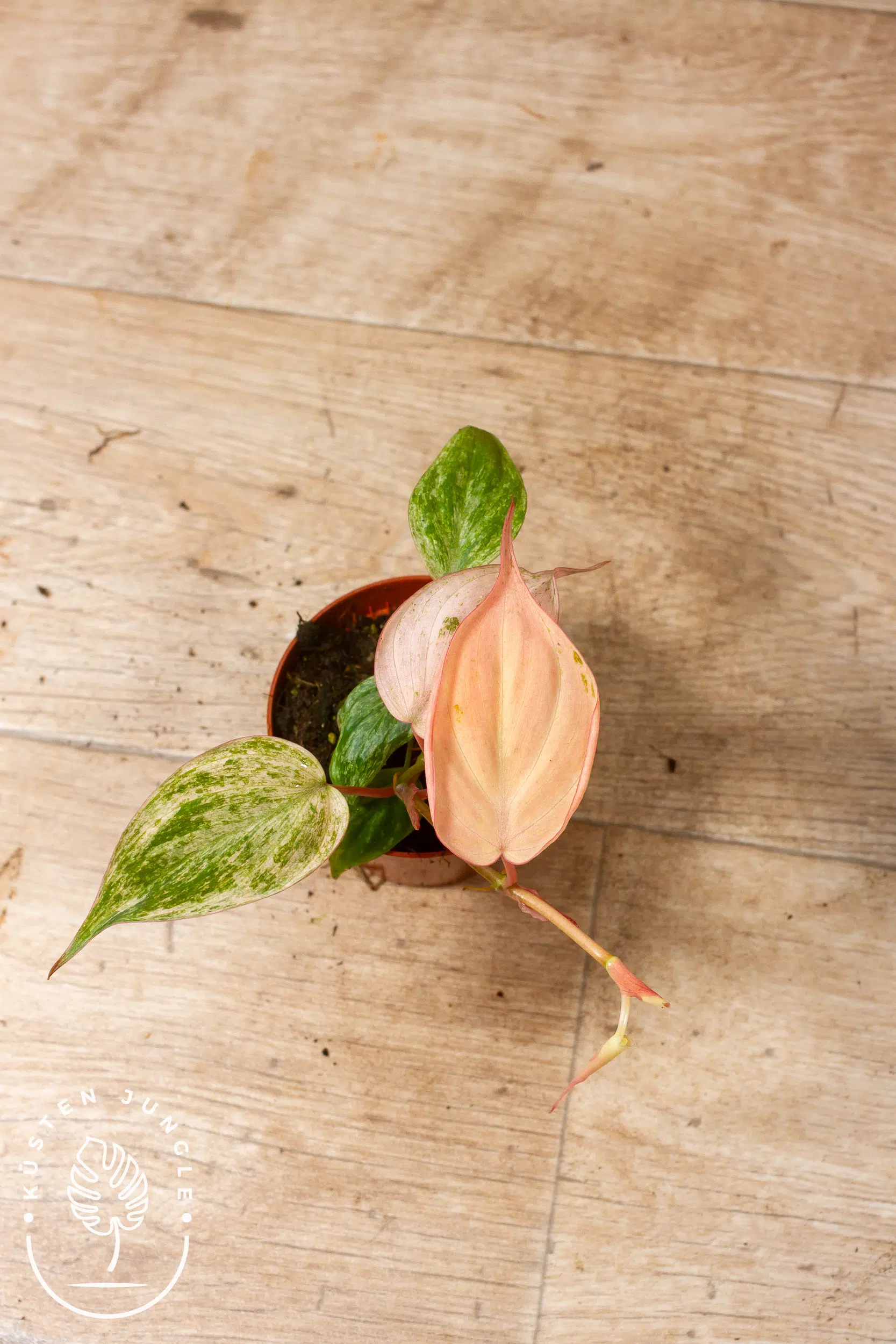
The velvety-soft, heart-shaped leaves shimmer between deep green, bronze, and violet, streaked with irregular pink, cream, to white marbling – no two leaves are exactly alike. New shoots often appear in a coppery pink hue before unfurling to their final color. This variety grows trailing or hanging and can be trained upwards on a moss pole or decoratively cascaded in a hanging basket.
Good to know
In trade, a distinction is occasionally made between true, genetically stable variegation and a pink coloring produced only chemically or hormonally, which is not permanent and fades over time. In true variegation, the pink and cream-colored leaf areas remain clearly defined, without yellowish intermediate tones.
Like all aroids, this plant also contains calcium oxalate crystals and is irritating to pets and children if ingested – it's best to place it out of reach. Regular inspection of the undersides of the leaves is also worthwhile, as spider mites and mealybugs are among the more common problems with philodendrons.