
Phyllanthus urinaria ‚Albo Variegata‘ - Care
Location & Light
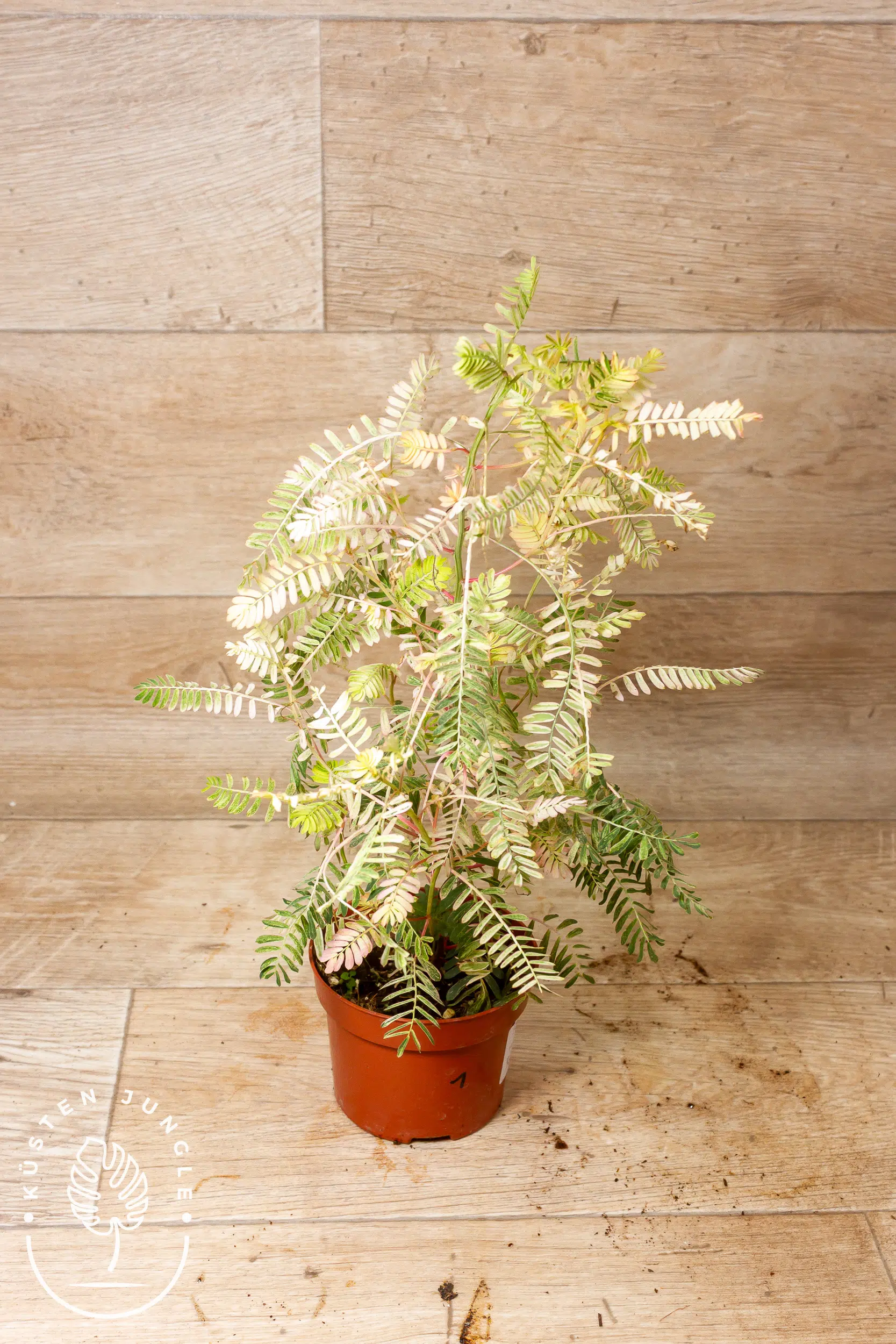
The green wild form of Phyllanthus urinaria tolerates full sun in its native habitat, but with the variegated ‚Albo Variegata‘, things are a bit different: the white leaf parts lack chlorophyll, causing them to burn faster than the green tissue in intense midday sun. A bright, sunny spot with filtered or only mild direct light provides the best balance between strong growth and stable, high-contrast variegation. If the plant is in too much shade, the white pattern will become paler and the already delicate growth will become even more lanky.
Pour
Consistently lightly moist, but never waterlogged – this best describes the needs of this delicate plant. Water as soon as the top millimeters of the substrate feel dry; complete drying out of the root ball will be met with drooping, wilting leaves, while permanent waterlogging will lead to root rot. Room-temperature, low-lime water is best tolerated. As its fine roots react quite sensitively, it's better to water more frequently in smaller amounts than rarely and thoroughly.
Fertilize
A highly diluted liquid fertilizer approximately every 4 to 6 weeks is perfectly sufficient for this rather delicately growing plant during its growth phase; it is not a heavy feeder. For this plant, approximate guidelines are a pH value of about 5.5 to 7.0 and an electrical conductivity of the irrigation water of around 1.0 to 1.5 mS/cm; for precise dosage, follow the manufacturer's instructions on the packaging. If it is only kept by a window in autumn and winter, fertilizing will be less frequent or not at all due to the weaker light; however, if it continues to grow year-round under sufficiently bright plant lighting, the usual rhythm can be maintained.
We consciously alternate between different fertilizers for our own plants – currently including COMPO COMPLETE, Foliage Focus, Liquid Gold Leaf, and Hesi TNT-Complex, supplemented with Hesi Root Complex, Hesi PowerZyme, and CalMag as needed.
Substrate
A loose, well-draining mixture of peat-reduced potting soil with a good amount of perlite or fine sand will suit it – the most important thing is that water can drain away quickly and no moisture accumulates at the bottom of the pot. A normal, not too large plastic or terracotta pot with a drainage hole is completely sufficient for the compact root ball.
Humidity & Temperature
This plant generally thrives in normal indoor air conditions ranging from 40 to 50 %, but at higher humidity levels—starting at around 60 %—it appears significantly more vigorous and is less prone to dry leaf edges. Warmth is more important to it than extreme humidity: it thrives best between 20 and 28 °C; temperatures below 15 °C and cold drafts should be avoided at all costs, as it reacts sensitively to them by dropping its leaves.
Growth & Form
Characteristic of this plant are the fine, feather-like branches with many small, oval leaflets that open in the morning and fold up again in the evening – a movement pattern it shares with the more well-known mimosa. As a shrub, it usually remains compact in cultivation and grows more bushy-loose than strongly branched. In the wild, the species is often short-lived; as a houseplant, it lasts significantly longer with stable warmth, though individual shoots may naturally decline over time. Those who wish to preserve the variety permanently are best advised to regularly take a few cuttings for propagation.
Good to know
In trade, alongside this white-cream variegated ‚Albo Variegata,‘ a separate variety called ‚Pink Variegata‘ with pink-cream marbling is also circulated. Both varieties look similar at first glance but differ significantly in coloration – this page is exclusively about the white variegated variant.
Unlike many other houseplants in our range, Phyllanthus urinaria does not contain calcium oxalate crystals and is considered largely harmless; the species is even traditionally used in herbal medicine. Nevertheless, consuming ornamental plants is generally not recommended, and it is best kept out of reach of pets and children.