
Alocasia reversa – Care
Location & Light
The Alocasia reversa feels most at home in a bright spot with plenty of indirect light, such as near an east or west window. While it can tolerate slightly less light, it will grow noticeably slower and produce long, thin petioles rather than compact leaves. On the other hand, you should avoid direct sunlight, as the leaves will quickly show signs of sunburn. If there is already little natural light available, a plant lamp will reliably help.
Pour
Water when the top 2 to 5 cm of the substrate have dried out. The root ball should then be evenly moist, but never waterlogged. Both too dry and permanently wet substrate will cause the Alocasia reversa to quickly react with limp, hanging leaves, which is why a consistent watering rhythm is important. Use room-temperature, low-lime water and always empty excess water from saucers or cachepots to prevent root rot. Water significantly less often in autumn and winter.
Fertilize
Like most Alocasias, Alocasia reversa is a heavy feeder and should be fertilized regularly during the growing season – approximately every 1 to 2 weeks with a highly diluted liquid fertilizer (one-quarter to a maximum of half the recommended amount), as the genus is considered salt-sensitive and over-fertilization quickly leads to brown leaf margins. A rough guideline for Alocasias in general is a pH value of about 5.5 to 6.5 and rather low EC values of 1.0 to 1.5 mS/cm. For precise dosage, follow the manufacturer's instructions on the respective packaging. If Alocasia reversa is only placed by the window in autumn and winter, the light weakens and fertilization should be reduced accordingly or paused; if it grows year-round under a softly set plant lamp, the usual rhythm can be maintained without further reduction.
We consciously alternate between different fertilizers for our own plants – currently including COMPO COMPLETE, Foliage Focus, Liquid Gold Leaf, and Hesi TNT-Complex, supplemented with Hesi Root Complex, Hesi PowerZyme, and CalMag as needed.
Substrate
In its native habitat, Alocasia reversa often grows among rocks and scree where there is hardly any soil – the potting mix should therefore be equally loose and well-draining. An aroid mix of potting soil, orchid bark, and perlite or coarse sand works well and prevents waterlogging of the sensitive roots. A pot that is significantly too large is more likely to keep the substrate wet for too long – Alocasia reversa prefers to be slightly root-bound and only needs to be repotted infrequently.
Humidity & Temperature
Alocasia reversa is one of the more demanding Alocasia species when it comes to humidity—normal indoor air humidity in the range of 40 to 50 % is usually not enough for it in the long run; it only begins to thrive at around 60 %. If the air is too dry, brown, crispy leaf edges will quickly appear. A humidifier, a bowl of pebbles, or a spot in the bathroom or in a display cabinet will reliably maintain higher humidity levels over the long term; however, you should avoid regularly misting the leaves, as standing moisture can encourage fungal and pest infestations. As for temperature, the ideal range is between 18 and 27 °C; temperatures consistently below 15 °C and cold drafts can quickly lead to leaf loss.
Growth & Dormancy
With a height and width of approximately 30 to 40 cm, the Alocasia reversa remains pleasantly compact and is also suitable for smaller locations. It does not experience a true, temperature-controlled winter dormancy at normal room temperatures; the light availability is the most crucial factor. If it is only placed by a window in autumn and winter, the noticeably weaker daylight will cause growth to slow down, and the plant may lose most or even all of its leaves. This is normal for this variety and not a cause for concern as long as the corm remains firm and healthy in the substrate. If, on the other hand, it grows year-round under a sufficiently bright plant lamp, growth usually remains stable even in winter, and significant leaf loss is avoided. With window-only placement, reduce watering and fertilizing accordingly during the darker period and patiently wait for new growth in spring.
Good to know
Like all Alocasias, Alocasia reversa contains calcium oxalate crystals and is irritating to pets and children if ingested – best to place it out of reach.
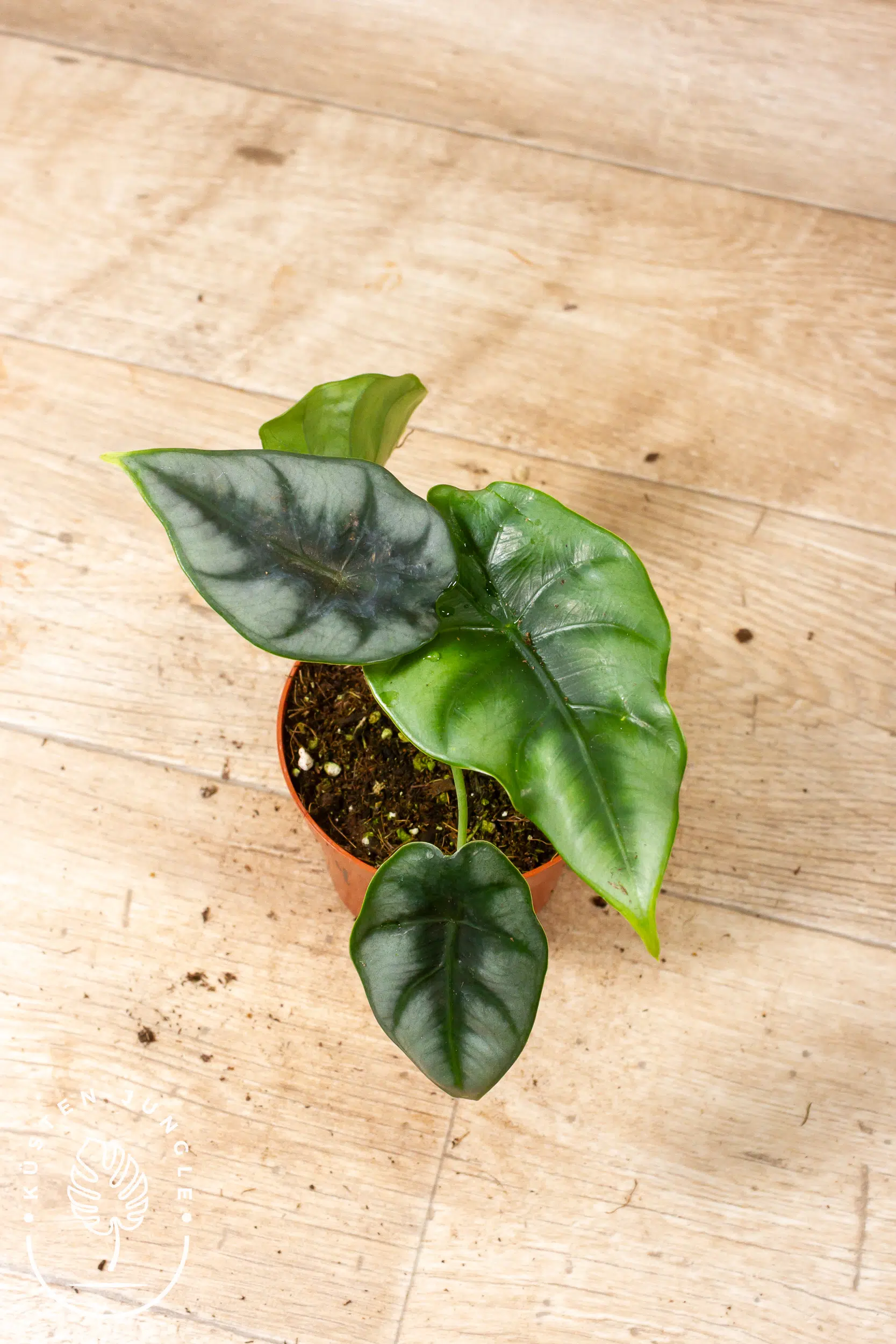
The Alocasia reversa owes its name to its unusual markings: while in most other Alocasias the leaf veins are lighter than the rest of the leaf surface, it's the exact opposite with this one – the midrib and veins show a strong dark green, while the rest of the leaf area shimmers a lighter, almost silvery-green. It originally comes from the island of Borneo, where it grows among rocks and rubble.
Regularly checking the undersides of leaves is worthwhile, as spider mites can appear, especially during dry, heated air in winter.