
Begonia ‚Black Mountain‘ - Care
Location & Light
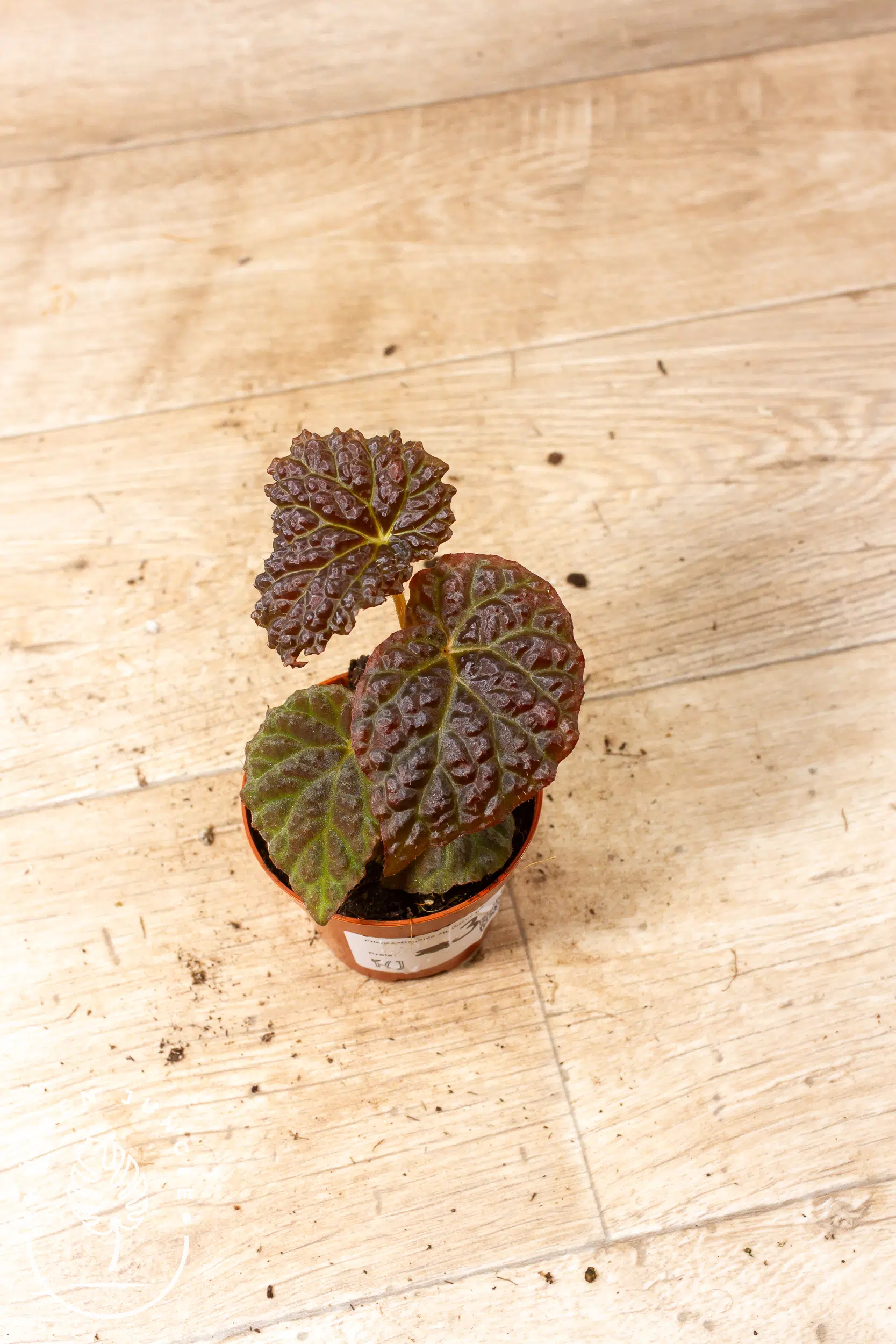
Full to partial shade with plenty of indirect light allows the Black Mountain to grow most vigorously and best displays its deep, dark, almost black leaf color. It can usually tolerate some mild morning or evening sun, but you should still avoid direct midday sun, as it can reduce the color intensity of the leaves and, in the worst case, lead to scorching. If there is insufficient light, the dark coloration will fade, and the plant will tend to grow leggy and stretched.
Pour
Water as soon as the top layer of substrate feels a little dry – the root ball should be evenly moist afterward, but never waterlogged. The Black Mountain is sensitive to waterlogging and quickly prone to root rot if the substrate remains constantly wet. Water at the base of the plant directly instead of over the heavily textured, velvety leaves, as water on the foliage quickly leads to unsightly spots or rot. In autumn and winter, when growth slows down, water significantly less.
Fertilize
During the growth phase, feed the Black Mountain with a heavily diluted liquid fertilizer (one-quarter to a maximum of half the recommended amount) every 3 to 4 weeks, as begonias are generally sensitive to high salt concentrations in the substrate. A rough guideline for begonias is a pH of approximately 5.2 to 6.0 and a rather low electrical conductivity of 0.5 to 1.3 mS/cm. Stick to the manufacturer's instructions on the respective packaging for precise dosage. If the plant is placed only by the window in autumn and winter, the light becomes weaker, and fertilization is reduced accordingly or paused. However, if it grows year-round under sufficiently bright plant lights, the usual rhythm can be maintained without further reduction.
We consciously alternate between different fertilizers for our own plants – currently including COMPO COMPLETE, Foliage Focus, Liquid Gold Leaf, and Hesi TNT-Complex, supplemented with Hesi Root Complex, Hesi PowerZyme, and CalMag as needed.
Substrate
A loose, airy, and well-draining substrate suits the Black Mountain best – a peat-poor, well-draining potting mix with some perlite works well and prevents waterlogging at the roots. Too large a pot should be avoided, as the substrate in it will remain moist longer than is good for this begonia.
Humidity & Temperature
Unlike many true terrarium begonias, the Black Mountain generally thrives even in normal indoor air conditions ranging from 40 to 50 %, but it grows noticeably more vigorously and develops richer leaf color at medium to high humidity levels between 50 and 70 %. A humidifier or a location with consistently higher humidity will help, but a terrarium isn’t strictly necessary. You should avoid spraying the leaves directly, as water droplets quickly leave stains on the velvety, dark surface. The ideal temperature range is between 18 and 24 °C; stable conditions without major fluctuations keep the leaf color at its most vibrant and prevent leaf loss.
Growth & Form
The Black Mountain grows rhizomatously, meaning via a creeping, ground-hugging underground stem, forming a compact, bushy, stocky growth habit. The highly textured, veined leaf surface with its velvety sheen often develops even more intensely in color as the leaves age. As a young plant in trade, the height is usually around 15 cm; how tall mature, well-established specimens become is not uniformly documented. A pronounced dormant period is not known, but growth is noticeably slower in winter.
Good to know
Like many begonias, Black Mountain contains calcium oxalate crystals and can cause irritation if ingested – it's best to keep it out of reach of children and pets.
Botanically, the Black Mountain is a cultivated form, likely originating from a cross between Begonia dracopelta and Begonia baik. It is characterized by a strongly arched, textured („bullate“) leaf surface with a velvety sheen, which shifts between deep dark green and almost black depending on the light.
Regularly checking the undersides of leaves is worthwhile, as spider mites and powdery mildew can occur, especially in air that is too dry or stale.