
Anthurium wendlingeri – Care
Location & Light
A bright spot with plenty of indirect light will help the Anthurium wendlingeri grow most vigorously, such as near an east or west window. As a rough guideline, the ideal range is around 80 to 150 µmol/m²/s PAR (PPFD), which, with a lighting duration of about 12 hours, corresponds to a DLI of approximately 3.5 to 6.5 mol/m²/day – this means it tends to tolerate slightly more light than many other anthuriums. However, you should still avoid direct sunlight, as the slightly velvety leaf surface can quickly burn from it. With too little light, it will continue to grow, but noticeably slower and with smaller leaves.
Pour
Water as soon as the top layer of substrate has dried slightly – the root ball should then be consistently moist, but never sodden. Unlike many other aroids, the wendlingeri tolerates short periods of substrate drying poorly and reacts sensitively to drought stress, which is why a consistent, more frequent watering rhythm is important. Room-temperature, low-lime water is best tolerated; always pour off excess water from saucers or cachepots to prevent waterlogging at the roots. Watering is noticeably reduced in autumn and winter, but even then, the root ball should not be allowed to dry out completely.
Fertilize
With good cultivation, Anthurium wendlingeri is among the faster-growing anthuriums and can tolerate slightly more nutrients than many other species – during the growth phase, feeding every 2 to 3 weeks with a highly diluted liquid fertilizer (a quarter to a maximum of half the recommended amount) is usually sufficient. Undernourished plants often show new leaves that are smaller than the previous ones. A rough guideline for anthuriums in general is a pH value of about 5.5 to 6.5 and rather low EC values of 1.0 to 1.5 mS/cm. For precise dosing, follow the manufacturer's instructions on the respective packaging. If the plant is only on the windowsill in autumn and winter, the light becomes weaker and fertilization is reduced accordingly or paused; however, if it grows year-round under sufficiently bright grow lights, the usual rhythm can be maintained without further reduction.
We consciously alternate between different fertilizers for our own plants – currently including COMPO COMPLETE, Foliage Focus, Liquid Gold Leaf, and Hesi TNT-Complex, supplemented with Hesi Root Complex, Hesi PowerZyme, and CalMag as needed.
Substrate
As an epiphyte, Anthurium wendlingeri requires a coarse, airy substrate that still retains moisture well – a mix of orchid bark, perlite, coco coir, or sphagnum moss, along with some charcoal, works well. Due to its heavy, drooping foliage, the plant also needs a secure stand or stable hanging support to prevent it from tipping over or slipping out of the pot due to its own weight. Every 2 to 3 years, it benefits from fresh substrate.
Humidity & Temperature
Normal indoor air is not sufficient for Anthurium wendlingeri in the long term—nearly all sources agree that consistently high humidity of at least 60 to 70 % is crucial for healthy, glossy leaves. At lower levels, the leaves become misshapen and the edges quickly turn brown and crispy. A humidifier, a tray of pebbles, or a spot among other tropical plants can help maintain these levels over the long term. You should avoid regularly misting the leaves, as moisture left on the foliage can promote fungal growth. The ideal temperature range is between 20 and 30 °C; cold drafts and sudden temperature fluctuations should be avoided at all costs.
Growth & Form
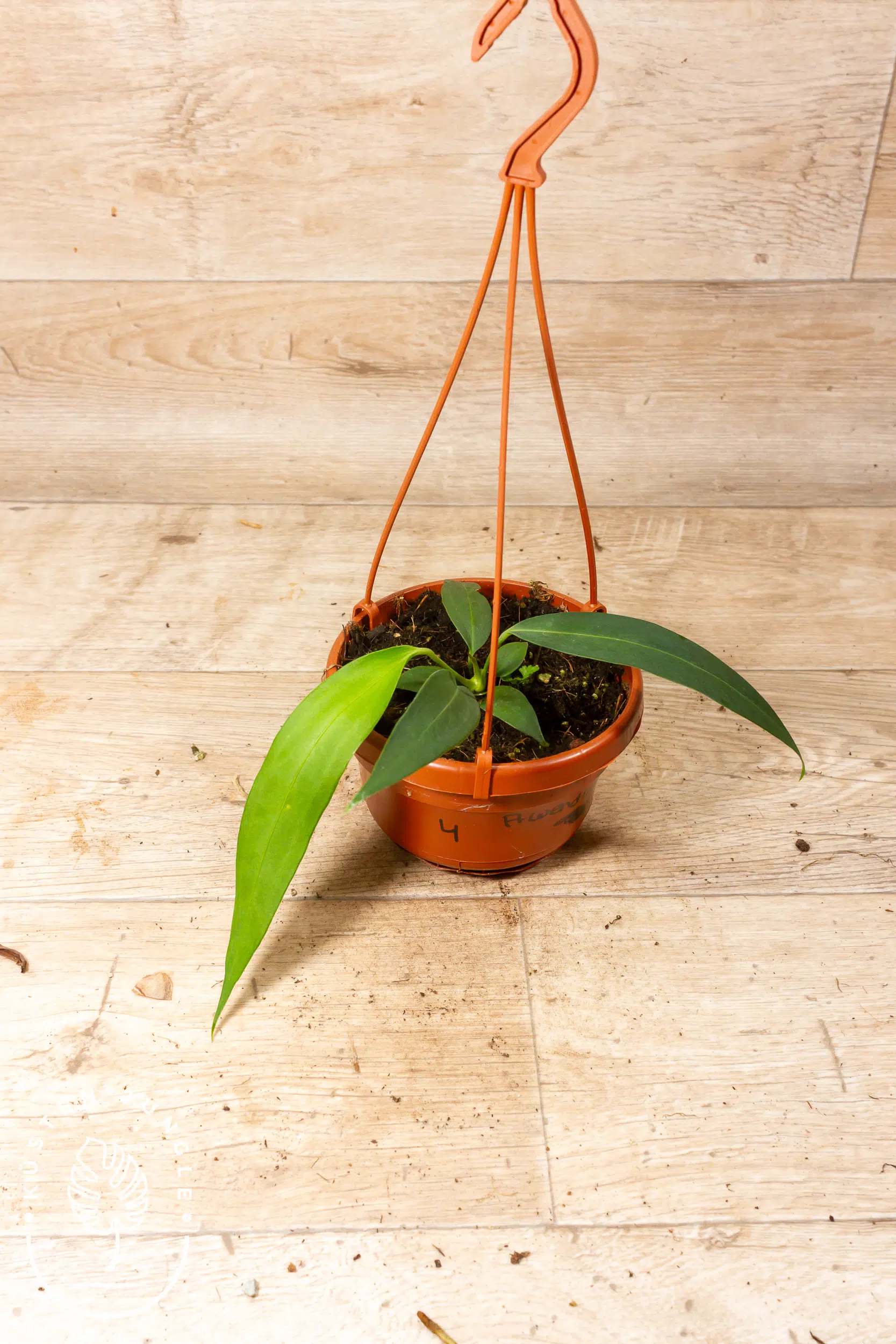
Anthurium wendlingeri forms long, narrow, slightly velvety leaves with a clearly visible midrib that hang down from a comparatively compact crown and can easily reach over a meter in length in cultivation. The pendulous growth is best showcased in a hanging basket or on a raised shelf. Mature plants occasionally produce a strikingly spirally twisted, corkscrew-like inflorescence, which makes the species particularly well-known among collectors. A distinct resting phase is not consistently documented, but growth slows noticeably in winter.
Good to know
Like all Anthuriums, wendlingeri also contains calcium oxalate crystals and is irritating to pets and children if ingested – it's best to place it out of reach.
The Anthurium wendlingeri originates from the humid mountain forests of Central America, from Costa Rica and Panama to northwestern Colombia, where it grows epiphytically. As a „strap-leaf“ anthurium, it looks quite similar to Anthurium vittarifolium at first glance, but differs significantly in its inflorescence: while the vittarifolium has a slender, straight spadix, the inflorescence of the wendlingeri twists in a corkscrew-like manner – hence the nickname „Spiral Anthurium.“.
Regularly checking the undersides of leaves is worthwhile, as scale insects, mealybugs, and spider mites like to hide there.