
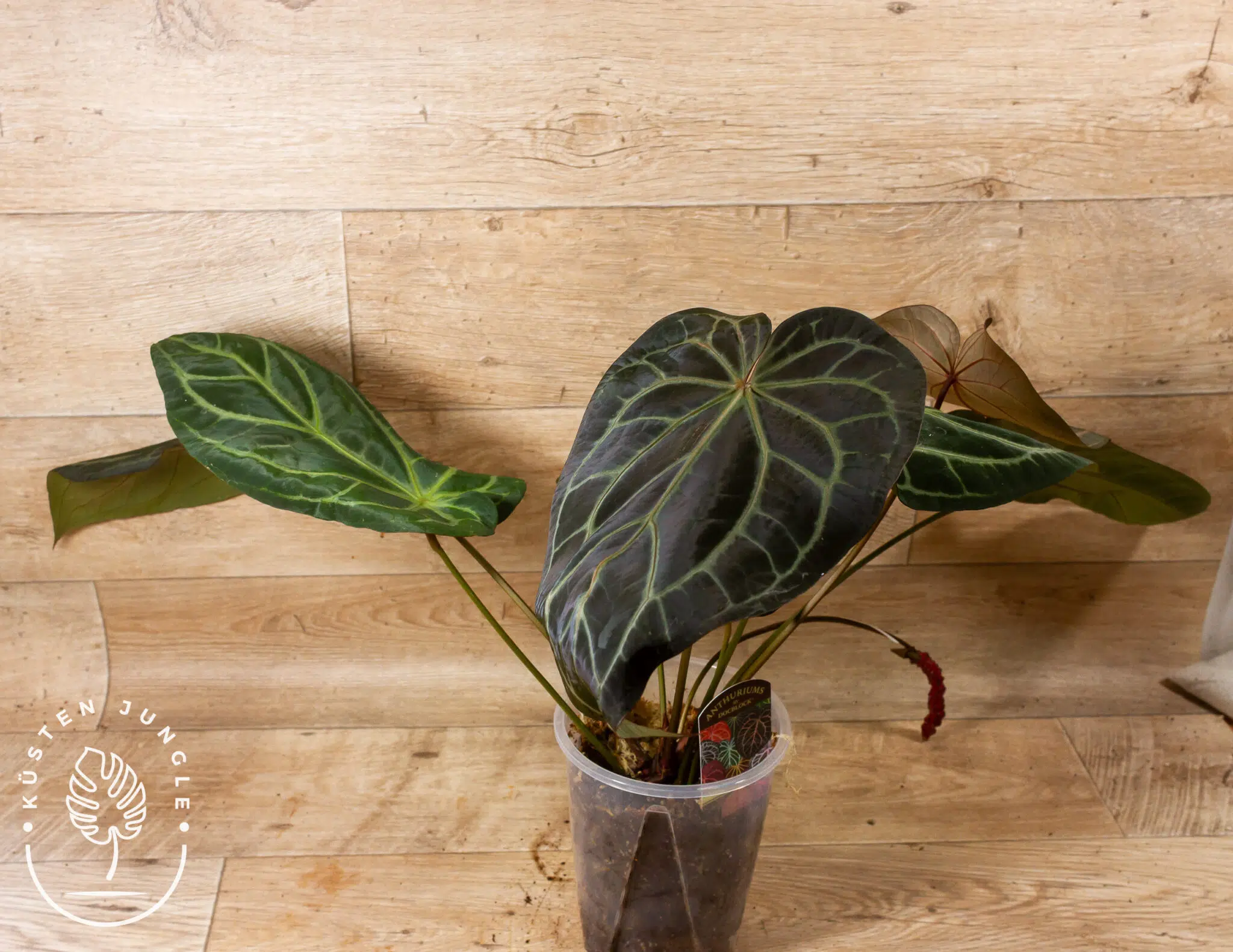
Anthurium DocBlock Zara® ‚3‘ x Zara® ’33‘ – Care
Location & Light
A bright location without direct sun is just right for this velvet leaf Anthurium. The fine, velvety leaf surface is made up of tiny, papilla-like cells that can capture even weaker light well – however, it still cannot tolerate harsh midday sun, as the leaves burn quickly then. As a rough guide, the suitable range is about 60 to 150 µmol/m²/s PAR (PPFD), which corresponds to a DLI of approximately 2 to 6.5 mol/m²/day with 10 to 12 hours of lighting. Locations that are too dark will make the typical high-contrast leaf pattern appear paler and further slow down its already leisurely growth.
Pour
Once the top layer of substrate (about 2 to 4 cm) feels dry, water thoroughly until excess water drains from the bottom. Always remove standing water from the cachepot afterward, as the fine roots are sensitive to waterlogging. Special care is worthwhile regarding water quality: soft water, preferably standing or filtered, is tolerated much better than hard tap water, which can otherwise lead to unsightly whitish deposits on the velvety leaf surface and brown leaf edges. During the cooler seasons, the amount of water should be noticeably reduced.
Fertilize
During the growth phase, a highly diluted, balanced aroid fertilizer every 4 to 6 weeks is quite sufficient – this Zara cross grows rather slowly and is by no means a heavy feeder; over-fertilizing is more likely to harm the fine roots than to benefit them. As a rough guideline, a pH of about 5.5 to 6.5 and an electrical conductivity of the irrigation water of around 1.0 to 1.5 mS/cm are generally considered suitable for anthuriums; it's best to follow the manufacturer's instructions for precise dosage. If the plant is only growing on a bright window in autumn and winter, it is fertilized less often or not at all due to the weaker light; conversely, if it receives consistently bright plant light year-round, fertilization can continue at the usual rhythm.
We consciously alternate between different fertilizers for our own plants – currently including COMPO COMPLETE, Foliage Focus, Liquid Gold Leaf, and Hesi TNT-Complex, supplemented with Hesi Root Complex, Hesi PowerZyme, and CalMag as needed.
Substrate
Above all, your roots need one thing: plenty of air. A chunky, very porous substrate made of orchid bark, coarse perlite, and some sphagnum moss or coconut coir chips forms the best foundation; dense, compacting potting soil should be avoided. A deep, but not too wide, pot with good drainage holes suits their rather compact root ball; for those who prefer a simpler approach, the plant can also be cultivated in semi-hydroponics using clay pebbles (LECA).
Humidity & Temperature
Unlike many hardier aroids, this Zara hybrid is actually quite sensitive to humidity: While it can survive for a while in normal indoor air with humidity levels between 40 and 50 %, it only shows true vitality with strong, large leaves at around 65 % or higher. A humidifier, a greenhouse cabinet, or a spot in a more humid bathroom will suit it well; if humidity remains very low for an extended period, the leaf margins may dry out. In terms of temperature, it thrives best between 18 and 26 °C; cold drafts and temperatures below 15 °C should be avoided at all costs.
Growth & Form
Unlike climbing aroids, this Anthurium grows upright as a compact rosette, requiring no support. The large, heart-shaped leaves emerge a warm reddish-brown, later maturing to a deep, almost blackish green with a visible reddish shimmer. They also feature the characteristic velvety texture and contrasting bright veining. Growth is slow to moderately fast; those expecting rapid results will be disappointed, but each new leaf becomes a small event.
Good to know
This plant is a sibling cross within the well-known DocBlock-Zara® line. Two individually selected clones of the same Zara line, designated with the numbers ‚3‘ and ’33‘, were crossed here. The original Zara line itself originates from a cross between Anthurium magnificum and a red-leaved Anthurium crystallinum cultivar by breeder Dr. Jeff Block. Accordingly, the seedlings of this line display the typical velvety leaf with a striking red-brown coloration when new growth emerges.
Compared to many other houseplants, this velvet leaf anthurium is more demanding to care for overall – especially consistently high humidity and soft watering are not just optional extras here, but make a noticeable difference for growth vigor and leaf quality.
Like all aroids, this Anthurium contains calcium oxalate crystals and is irritating to pets and children if ingested – it's best to place it out of reach. Regularly checking the undersides of the leaves is also worthwhile, as thrips and spider mites are among the most common pests in this plant group.