
Philodendron ‚Felix‘ - Care
Location & Light
A bright spot with filtered, indirect light best showcases Felix's shiny leaf surface and deep ribbing. While the plant can tolerate slightly less light, this already slow grower will become noticeably slower. Direct midday sun should be avoided, as it quickly causes light scorch marks on the dark leaves. As a rough guideline, the suitable range is around 100 to 200 µmol/m²/s PAR (PPFD), which corresponds to a DLI of approximately 4 to 8 mol/m²/day.
Pour
Water again as soon as the top 1-2 inches of the substrate feel dry – the root ball should then be evenly moist without any water standing in the pot. This Philodendron hybrid does not tolerate constant wetness well and reacts with root rot, while complete drying out leads to limp leaves. In the cooler season, when growth slows down anyway, water significantly less often.
Fertilize
Because ‚Felix‘ grows slowly anyway, a heavily diluted fertilizer application every 4 to 6 weeks during the growing season is completely sufficient – more frequent fertilizing will hardly accelerate growth in this variety, but will increase the risk of nutrient salt damage to the roots. General guidelines for Philodendrons are a pH range of about 5.5 to 6.5 and an electrical conductivity of the irrigation water of roughly 1.0 to 1.5 mS/cm; follow the manufacturer's instructions for precise dosage. If the plant is only placed by the window in autumn and winter, fertilization will be less frequent or not at all due to the diminishing light; if, on the other hand, it continues to grow year-round under sufficiently bright grow lights, fertilization can continue at the usual rhythm.
We consciously alternate between different fertilizers for our own plants – currently including COMPO COMPLETE, Foliage Focus, Liquid Gold Leaf, and Hesi TNT-Complex, supplemented with Hesi Root Complex, Hesi PowerZyme, and CalMag as needed.
Substrate
A coarse, airy mixture of potting soil, orchid bark, and perlite gives the roots enough support and oxygen without waterlogging. A moss pole or a small trellis will support the climbing growth habit and encourage the formation of larger, more deeply ribbed leaves as the plant grows up it.
Humidity & Temperature
Normal indoor air humidity of 40 to 50 % is generally sufficient for ‚Felix,‘ but at levels of 60 % or higher, growth becomes noticeably more vigorous and the leaves remain flawless for longer. A humidifier or a bowl of pebbles can help if needed. The ideal temperature range is between 18 and 27 °C; cold drafts and temperatures below 15 °C should be avoided.
Growth & Support
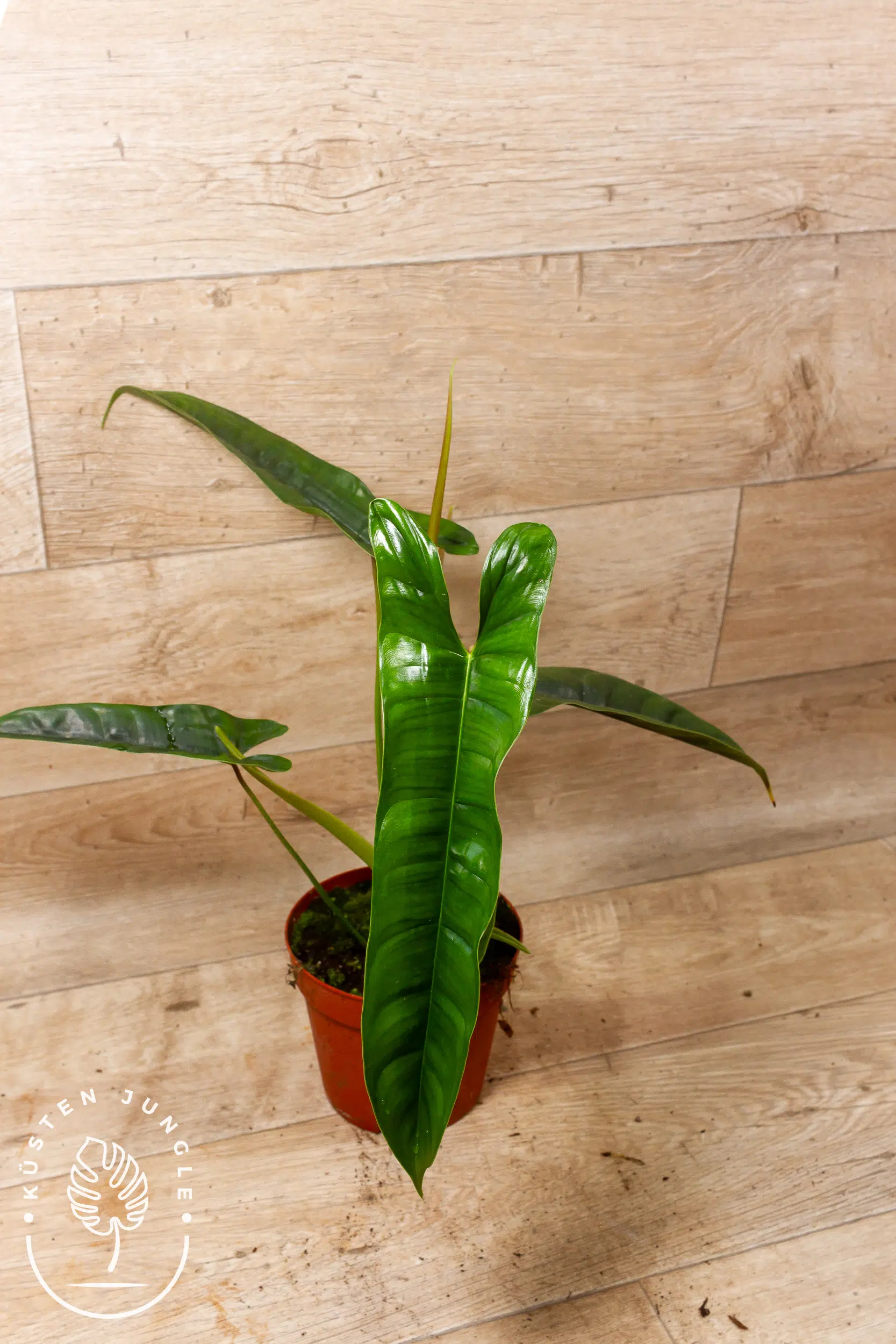
‚Felix‘ grows as a climbing aroid with large, dark green, shiny leaves, which are traversed by light veins and characterized by deep, wavy ruffles – a feature that gives the plant its plastic-looking, almost textured appearance. Guided by a moss pole, the leaves become noticeably larger over time than when grown freely hanging. Those expecting quick results should bring some patience: this variety is among the slower-growing Philodendron hybrids, but each new leaf impresses with its distinct structure.
Good to know
Philodendron ‚Felix‘ has not yet been officially described botanically, so it is usually sold commercially as a hybrid or under the designation Philodendron sp. „Felix“. It originally comes from Ecuador, and its exact parentage has not been definitively documented.
Like all aroids, this plant also contains calcium oxalate crystals and is irritating to pets and children if ingested – it's best to place it out of reach. Regular inspection of the undersides of the leaves is also worthwhile, as spider mites and mealybugs are among the more common problems with philodendrons.