
Alocasia ‚Maharani‘ – Care
Location & Light
A bright spot with plenty of indirect light best showcases the Alocasia's distinctive, dragon-skin-like leaf structure. Direct sun, especially at midday, quickly leads to unsightly brown burns on the thick, leathery leaves. Conversely, a lack of light results in leggy growth and a less defined central structure. As a general guideline for the genus, Alocasias typically require around 150 to 350 µmol/m²/s PAR (PPFD), which, with 10 to 12 hours of lighting, corresponds to a DLI of approximately 6.5 to 15 mol/m²/day.
Pour
Water moderately once the top 2 to 3 cm of the substrate are dry – the root ball should then be evenly moist, but never waterlogged. This Alocasia hardly tolerates waterlogging and reacts to it with rotten roots or a soft tuber base. Room-temperature, low-lime water is tolerated much better than hard tap water, and excess water in the saucer should always be removed.
Fertilize
Like most Alocasias, the ‚Maharani‘ is a heavy feeder. During the growing season, it should be fertilized approximately every 1 to 2 weeks with a highly diluted liquid fertilizer, preferably with every or every other watering. General guidelines for the genus suggest a pH range of about 5.5 to 6.5 and an electrical conductivity of irrigation water of roughly 1.0 to 2.0 mS/cm; for precise dosage, follow the manufacturer's instructions. If the plant is placed only by a window in autumn and winter, fertilization will be less frequent or not at all due to weaker light. However, under consistently bright plant light year-round, you can continue fertilizing at the usual frequent rhythm.
We consciously alternate between different fertilizers for our own plants – currently including COMPO COMPLETE, Foliage Focus, Liquid Gold Leaf, and Hesi TNT-Complex, supplemented with Hesi Root Complex, Hesi PowerZyme, and CalMag as needed.
Substrate
A nutrient-rich yet well-draining mix of potting soil, perlite, and some orchid bark suits this Alocasia well. It's important to use a pot with sufficient drainage holes so that excess water can drain away quickly and the bulb doesn't sit in moisture permanently.
Humidity & Temperature
Normal indoor air humidity levels of 40 to 50 % are tolerable, but the ‚Maharani‘ only feels truly comfortable at levels between 60 and 80 %, such as those found in a small plant display case or a greenhouse cabinet. A humidifier or a bowl of pebbles can help maintain optimal conditions in a normal room environment. The ideal temperature range is between 18 and 27 °C; cold drafts and temperatures below 15 °C should be avoided.
Growth & Dormancy
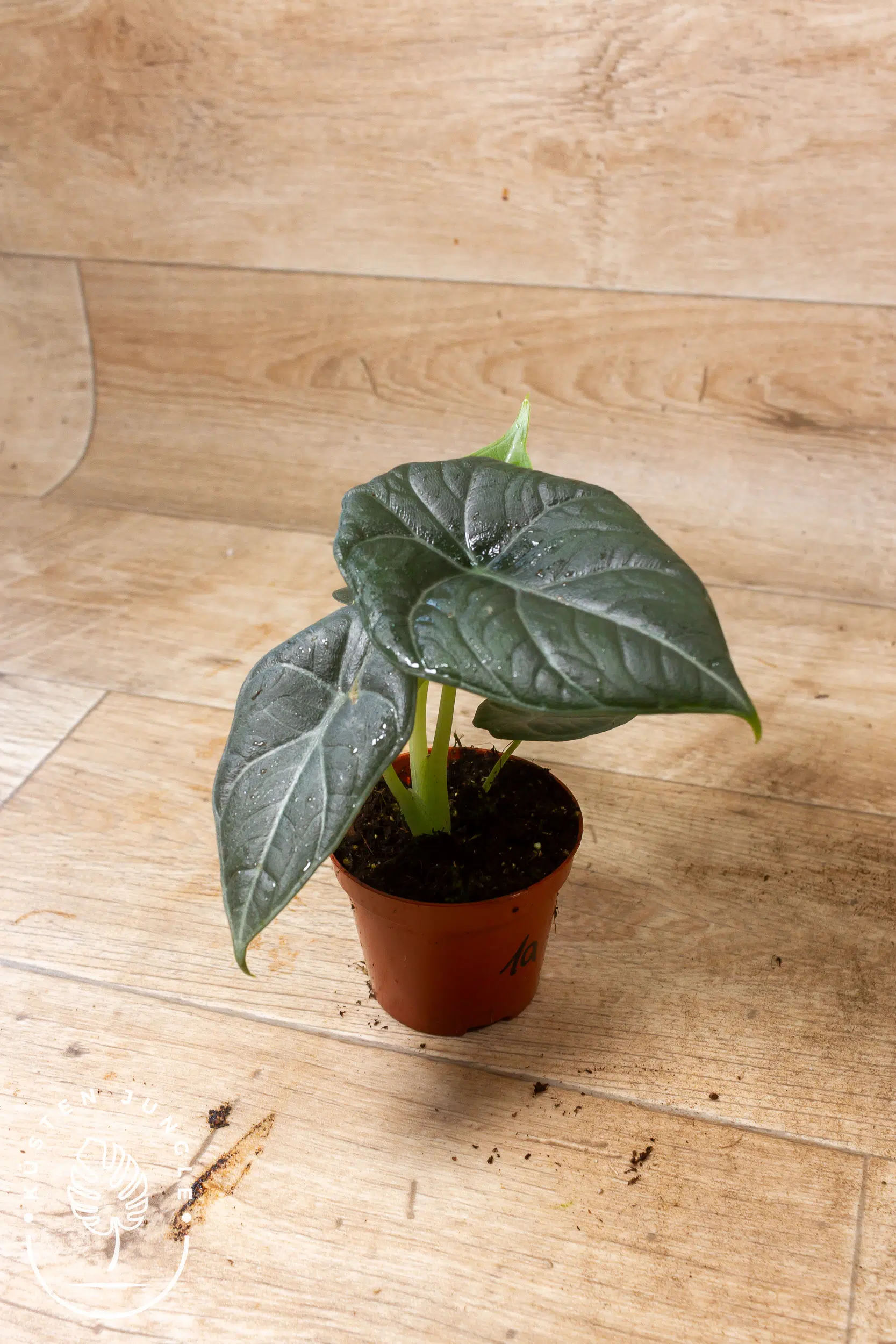
The ‚Maharani‘ grows compactly and upright from a bulbous base, with thick, deeply veined leaves, the underside of which often shimmers in a rich Bordeaux red – a pretty contrast to the gray-green upper side of the leaves. If it only grows by the window in autumn and winter, growth slows down noticeably due to the weaker light, and individual older leaves may be shed; however, with sufficient bright plant light year-round, growth usually remains stable. Overall, this variety remains significantly smaller than many other Alocasias, rarely exceeding 30 to 40 cm even when fully grown.
Good to know
Alocasia ‚Maharani‘ is a deliberately bred hybrid of Alocasia reginula and Alocasia melo, and like ‚Dragon Scale‘ or Alocasia cuprea, it belongs to the so-called Jewel Alocasias – an informal term for compact Alocasias with particularly structured leaf surfaces. Variegated forms like ‚Maharani‘ Albo or ‚Maharani‘ Aurea are separate cultivars with sometimes different light requirements and are not discussed here.
Like all Araceae, this Alocasia contains calcium oxalate crystals and is irritating to pets and children if ingested – best to place it out of reach. Regular inspection of the undersides of the leaves is also worthwhile, as spider mites are among the more common problems with this variety, especially in excessively dry air.