
Labisia sp. ‚Jambi‘ - Care
Location & Light
On the floor of the shady Sumatran forests, this Labisia receives little direct light, so it feels most at home with us in a bright, but shady to semi-shady location. Too much direct light will fade the strong, sometimes metallic shimmering leaf color, while locations that are too dark will further slow its already leisurely growth. As a guideline for houseplants of this genus, only about 30 to 60 µmol/m²/s PAR (PPFD) is considered suitable, which corresponds to a DLI of approximately 1.5 to 2.5 mol/m²/day – significantly more shade-tolerant than most other houseplants.
Pour
Once the top 2 to 3 cm of the substrate are dry, water thoroughly until water drains from the drainage holes – excess water in the saucer should not remain afterward. More important than a rigid watering schedule is consistency: the plant likes neither to dry out completely nor to stand in water permanently. In winter, when growth is dormant, more time can pass between waterings.
Fertilize
Since these Labisia grow quite slowly, a well-diluted liquid fertilizer every 4 to 6 weeks during the growing season is perfectly sufficient – more would hardly benefit their leisurely growth. The pH value of approximately 5.5 to 6.5 and an electrical conductivity of the irrigation water of roughly 1.0 to 1.5 mS/cm are considered guidelines for the genus. If the plant is only kept by the window in autumn and winter, less or no fertilizer is applied due to the weaker light; however, with year-round bright plant lamp lighting, fertilization can continue at the usual rhythm.
We consciously alternate between different fertilizers for our own plants – currently including COMPO COMPLETE, Foliage Focus, Liquid Gold Leaf, and Hesi TNT-Complex, supplemented with Hesi Root Complex, Hesi PowerZyme, and CalMag as needed.
Substrate
A loose, well-draining substrate made of fine orchid bark, perlite, and some coco coir or peat moss allows excess water to drain quickly and prevents root rot. A pot with good drainage is a must, as the roots cannot tolerate constantly wet conditions.
Humidity & Temperature
When it comes to humidity, this Labisia is indeed demanding: levels of 60 to 80 % are considered necessary for it to thrive; if the air remains dry for an extended period, the leaf edges will quickly become crispy and brown. A closed or semi-open terrarium or a plant display case is therefore much better suited than an open windowsill; if you want to try growing it without a display case, you should definitely use a humidifier. As for temperature, the ideal range is between 20 and 28 °C; cooler drafts should be avoided.
Growth & Form
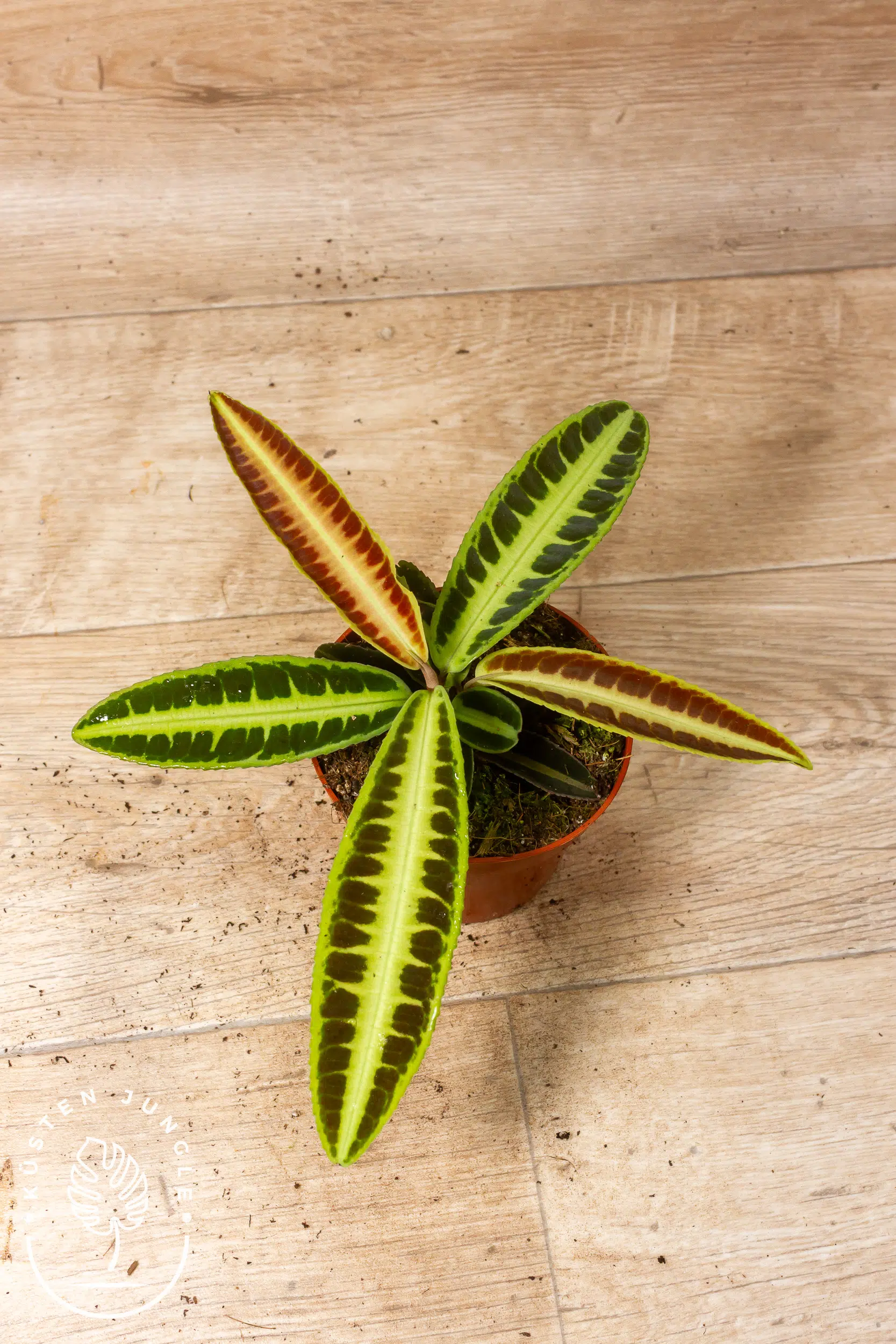
This Labisia grows upright and narrow rather than creeping, with narrow leaves up to about 18 cm long and only 4 to 7 cm wide. The leaf margin and midrib appear light green, while the area in between is dark green to black and often shimmers reddish on fresh leaves – the exact color intensity depends heavily on the light. The overall growth is slow, and new leaves are a reliable sign that the care is appropriate. This compact species does not require support for climbing.
Good to know
This Labisia originates from the vicinity of Jambi city in Sumatra; the spelling „Jabi“ is also common in trade, which is likely simply a misspelling of the place of origin. There is currently no reliable data on the pet compatibility of Labisia, so it should be kept out of reach of curious pets as a precaution.