
Philodendron ‚Florida Ghost‘ - Care
Location & Light
Bright, indirect, and well-filtered light best showcases the ghostly white young leaves of this Philodendron. An east or west window with some distance works well, while a thin curtain can help at a south-facing window. Direct sun quickly burns the particularly light, chlorophyll-poor young leaves, whereas placing it in too much darkness makes its growth tougher.
Pour
Once the top 2 to 3 cm of the substrate are dry, water thoroughly until it penetrates the soil – usually once a week is enough during the growth phase. In winter, the soil can dry out a bit longer between waterings. Standing water in the pot should be consistently avoided, so always drain excess water.
Fertilize
During the growth phase from spring to summer, a well-diluted liquid fertilizer every 2 to 4 weeks is sufficient; fertilization should be discontinued in autumn and winter. Recommended guidelines for the genus are a pH value of approximately 5.5 to 6.5 and an electrical conductivity of the irrigation water of roughly 1.0 to 2.0 mS/cm. If the plant is placed only by a window in autumn and winter, fertilization will not be necessary anyway due to the weaker light. However, with year-round bright plant lamp lighting, fertilization can continue somewhat longer at the normal rhythm.
We consciously alternate between different fertilizers for our own plants – currently including COMPO COMPLETE, Foliage Focus, Liquid Gold Leaf, and Hesi TNT-Complex, supplemented with Hesi Root Complex, Hesi PowerZyme, and CalMag as needed.
Substrate
A loose, airy aroid substrate made of orchid bark, perlite, and some coco coir or peat moss ensures proper drainage. A pot with good drainage is important; repotting is usually done every 12 to 24 months, as soon as the roots grow out of the drainage holes or the root ball becomes dense.
Humidity & Temperature
This Philodendron thrives in normal indoor air conditions, but at a humidity level of about 50 to 70 %, its characteristic light-colored young leaves appear even more vibrant and its overall growth is more vigorous. In heated rooms during the winter, the air can quickly become too dry; a humidifier or placing the plant near other plants can help alleviate this. The ideal temperature range is between 18 and 27 °C; below 15 °C, growth slows noticeably.
Growth & Support
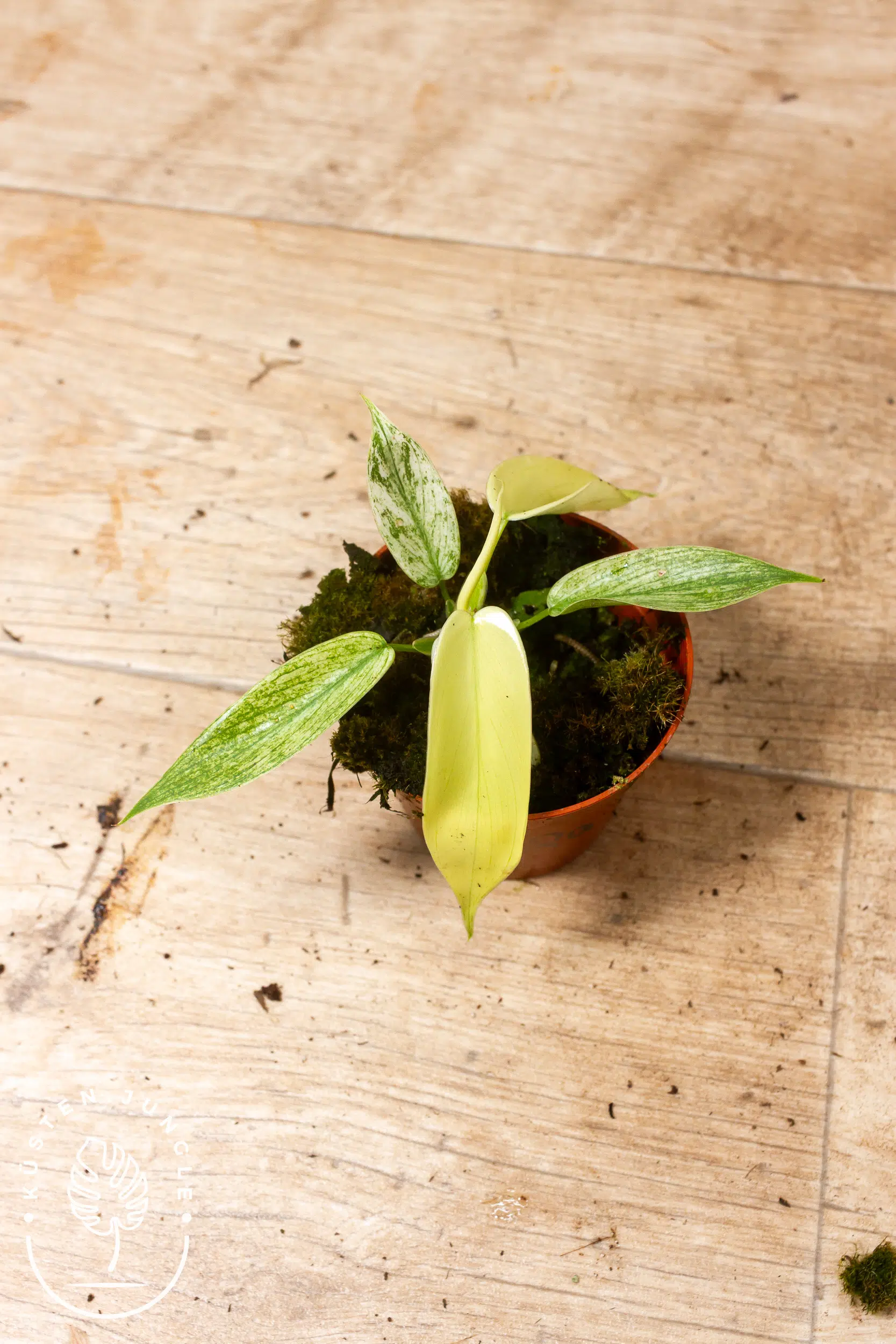
The striking leaf development gives it its name: new leaves unfurl from their cocoon almost spookily white, initially lighten to yellow-green, and finally darken to a rich, glossy green – often showing several color stages simultaneously on the same plant. As a climbing Philodendron, it develops larger, more deeply lobed leaves on a moss pole than in free-standing growth. With window-only cultivation in autumn and winter, growth significantly slows down due to weaker light; however, with year-round bright plant lamp illumination, growth remains largely uniform.
Good to know
‚Florida Ghost‘ belongs to the group of ‚Florida‘ hybrids, which are generally attributed to a mid-20th-century cross in cultivation; however, there is no definitively documented botanical origin. The green-leaved original form ‚Florida‘ without the typical white juvenile leaves is occasionally sold under the same name – a true ‚Ghost‘ reliably shows the namesake, ghostly white on every new leaf.
Like all aroids, this Philodendron also contains calcium oxalate crystals and is irritating to pets and children if ingested – best to place it out of reach.