
Alocasia plumbea ‚Flying Squid‘ - Care
Location & Light
This Alocasia noticeably requires more light than some of its broad-leaved relatives to vigorously develop its quirky growth habit with thread-thin leaf blades – a spot in a bright west-facing or slightly shielded south-facing window is suitable, but direct midday sun should be avoided. If it's too dark, it quickly loses leaves, as the plant only retains as much foliage as the available light can support. For this species, typical values for the genus are around 150 to 300 µmol/m²/s PAR (PPFD), which corresponds to a DLI of approximately 6 to 12 mol/m²/day.
Pour
The top 1 to 2 inches of the substrate should be allowed to dry out between waterings, then water thoroughly and evenly. Depending on the season and light conditions, this will be about every 7 to 10 days, and less often in winter. Excess water should never remain in the saucer, as the plant will react to constantly wet roots with rot.
Fertilize
Like most Alocasias, ‚Flying Squid‘ is a heavy feeder and should be supplied with a highly diluted liquid fertilizer every 1 to 2 weeks during its growth phase. For the genus, the recommended pH value is around 5.5 to 6.5, and the electrical conductivity of the irrigation water is roughly 1.0 to 1.5 mS/cm. If the plant is only placed by the window in autumn and winter, it is fertilized less frequently or not at all due to the weaker light; however, if the plant is illuminated year-round by bright grow lights, fertilization can continue at the usual rhythm.
We consciously alternate between different fertilizers for our own plants – currently including COMPO COMPLETE, Foliage Focus, Liquid Gold Leaf, and Hesi TNT-Complex, supplemented with Hesi Root Complex, Hesi PowerZyme, and CalMag as needed.
Substrate
A coarse, well-draining aroid mix of orchid bark, perlite, and some coco coir ensures ample air circulation to the roots and allows excess water to drain quickly. A pot with good drainage is essential for this Alocasia to prevent the roots from sitting in moisture constantly.
Humidity & Temperature
Normal indoor air is generally sufficient for this Alocasia, but at humidity levels of around 60 % or higher, it becomes noticeably more vigorous and produces fuller, stronger shoots. Placing it near other plants or having a small humidifier nearby can also help, but it’s not essential. The ideal temperature range is between 18 and 28 °C; below about 15 °C, growth slows noticeably.
Growth & Dormancy
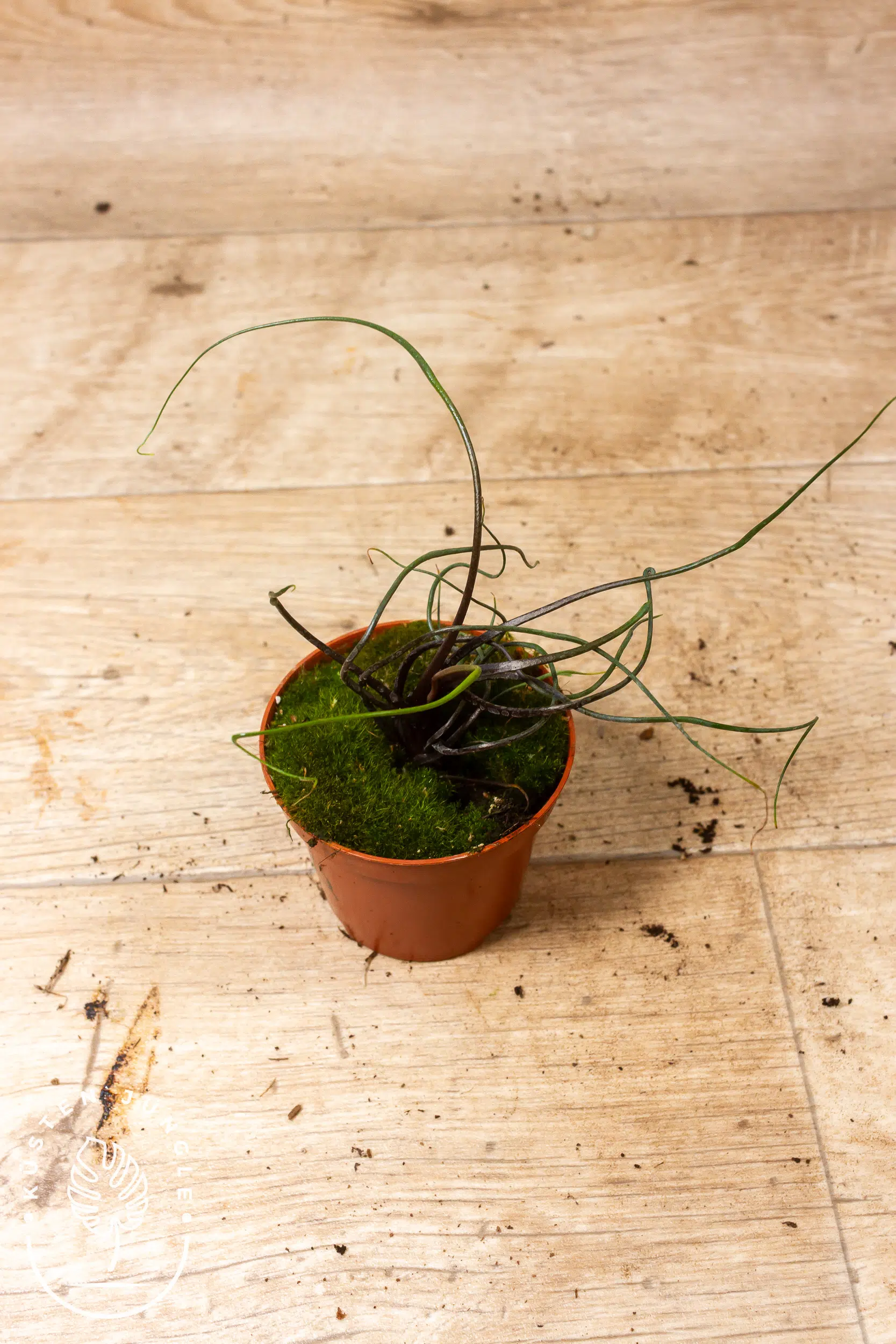
Instead of broad leaf blades, this mutant forms long, often spirally twisted petioles with only thread-like reduced blades – a visually unusual appearance that gives the plant its name. The overall growth remains compact and is well-suited for smaller windowsills or shelves. With only window placement in autumn and winter, growth slows down noticeably due to weaker light, and individual older leaves may be shed; under year-round bright plant lamp lighting, however, growth remains largely uniform.
Good to know
‚Flying Squid‘ is a spontaneous mutation of Alocasia plumbea, where the leaf blade is reduced to thin, tentacle-like threads instead of forming the usual broad leaf surface – hence the name. Like other Alocasias, it grows from an underground rhizome, from which new shoots can form over time; this should not be damaged or removed when repotting.
Like all Araceae, this Alocasia also contains calcium oxalate crystals and is irritating if ingested by pets and children – best to place it out of reach.