
Anthurium ‚Red Crystallinum‘ - Care
Location & Light
As an epiphyte from the canopy of tropical forests, this anthurium is accustomed to bright but well-filtered light – direct sun quickly burns the velvety leaf surface, especially the still delicate red young leaves. A spot with plenty of indirect light in an east-facing or slightly set-back south-facing window is suitable. As reference values for the genus, this species is considered to have approximately 80 to 150 µmol/m²/s PAR (PPFD), which corresponds to a DLI of about 3 to 6 mol/m²/day – if placed too dark, growth becomes sluggish and the strong red coloring of the new leaves is less pronounced.
Pour
Watering should be done once the top 2 to 3 cm of the substrate feel dry, but then thoroughly and deeply. The thick roots are sensitive to constant waterlogging and rot quite quickly, whereas the plant tolerates longer dry periods much better. Soft or stale water is usually better tolerated than hard tap water, which can shift the pH value in the substrate over time.
Fertilize
As a hybrid, ‚Red Crystallinum‘ grows noticeably faster than the pure species and should therefore be fertilized regularly during the growth phase from spring to late summer – a well-diluted liquid fertilizer about every 3 to 4 weeks is usually sufficient. As guideline values for the genus, a pH of about 5.5 to 6.5 and an electrical conductivity of the irrigation water of roughly 1.0 to 1.5 mS/cm are considered. If the plant is only by the window in autumn and winter, less or no fertilization occurs due to the weaker light; however, under year-round bright plant lamp lighting, fertilization can continue at the usual rhythm.
We consciously alternate between different fertilizers for our own plants – currently including COMPO COMPLETE, Foliage Focus, Liquid Gold Leaf, and Hesi TNT-Complex, supplemented with Hesi Root Complex, Hesi PowerZyme, and CalMag as needed.
Substrate
A coarse, very permeable substrate made of orchid bark, perlite, and some sphagnum moss or coconut fiber comes closest to the epiphytic roots. Alternatively, pure sphagnum moss also works well, but should then be kept evenly slightly moist rather than wet. A pot with good drainage holes is particularly important for this species, which is sensitive to waterlogging.
Humidity & Temperature
Normal indoor air is sufficient for this Anthurium to survive, but it really thrives only at temperatures of about 60 % or higher; at these temperatures, the leaf margins remain smooth and the velvety texture is shown off to its best advantage. If the air remains dry for extended periods, the margins may become slightly crisp. A humidifier or a spot by a sunny window helps significantly here, whereas misting has little effect. The ideal temperature range is between 18 and 27 °C; the plant does not tolerate temperatures consistently below 16 °C well.
Growth & Form
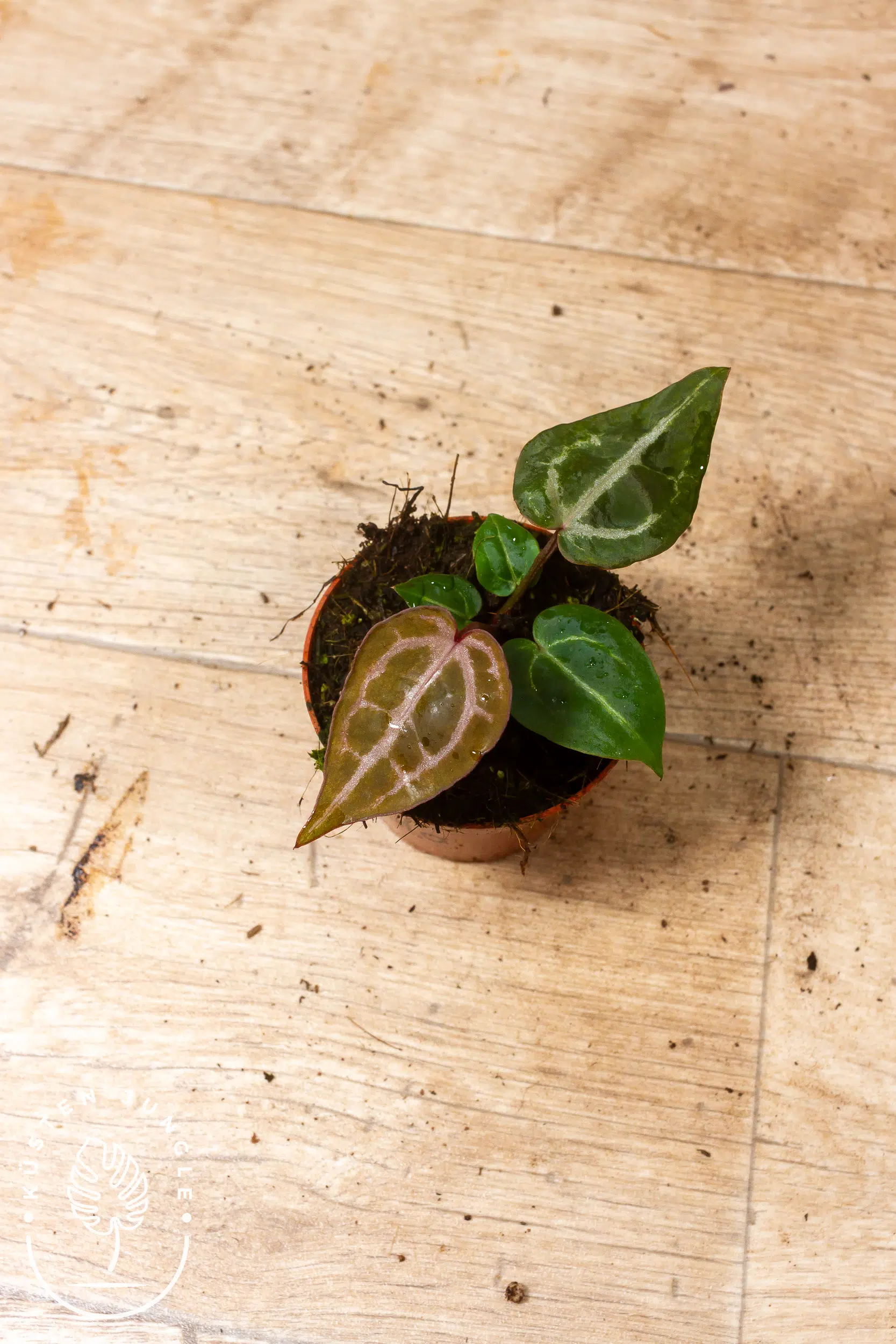
As a self-heading rosette plant, ‚Red Crystallinum‘ does not form climbing shoots and therefore requires no support. The striking color development of its leaves gives it its name: young leaves emerge in a bright red to burgundy with pronounced white veining, darken through an intermediate purple hue, and finally turn deep green, with the midrib and veins often retaining a reddish sheen for longer. With cultivation exclusively on a windowsill in autumn and winter, growth noticeably slows due to weaker light; however, with year-round bright plant lamp illumination, growth remains largely consistent.
Good to know
‚Red Crystallinum‘ is not a pure species, but rather a hybrid developed by American breeder Tim Anderson, likely involving Anthurium crystallinum, A. magnificum, and A. dressleri. In contrast, the pure Anthurium crystallinum displays a consistently deep green color with silvery-white veining from the outset, without the red juvenile leaf coloration of this hybrid.
Like all aroids, this Anthurium also contains calcium oxalate crystals and is irritating to pets and children if ingested – best to place out of reach.