
Begonia ferox – Care
Location & Light
In its native habitat, this begonia grows on the ground in shady, subtropical forests directly on limestone rocks – accordingly, it feels most at home in a bright to partially shaded location without direct sun. Intense sun quickly burns the sensitive, slightly hairy leaves. A north-facing window or a brighter window filtered by curtains is well-suited. If it's too dark, growth will be maintained, but the characteristic raised areas will form more slowly and less distinctly.
Pour
The top 2 to 3 cm of the substrate may dry out slightly between waterings, after which water evenly without getting the leaves wet – otherwise, fungal spots can quickly develop. Water low in lime or left standing is tolerated significantly better than hard tap water, which can shift the pH of the substrate upwards in the long run. Standing water in the saucer should be poured off after 30 minutes at the latest, otherwise the roots will rot.
Fertilize
From spring to summer, a well-diluted liquid fertilizer every 3 to 4 weeks is sufficient; fertilizer is completely omitted in autumn and winter. As guideline values for the genus, a pH value of approximately 5.5 to 6.5 and an electrical conductivity of the irrigation water of roughly 1.0 to 1.5 mS/cm are considered. If the plant is only by the window in autumn and winter, no further fertilization will occur due to the weaker light anyway; however, with year-round bright plant lamp lighting, fertilization can continue at the normal rhythm for a while longer before being reduced here as well.
We consciously alternate between different fertilizers for our own plants – currently including COMPO COMPLETE, Foliage Focus, Liquid Gold Leaf, and Hesi TNT-Complex, supplemented with Hesi Root Complex, Hesi PowerZyme, and CalMag as needed.
Substrate
A loose, slightly acidic to neutral, and very airy substrate is most beneficial for this begonia – a high-quality houseplant soil or a mixture of sphagnum moss and perlite works well. A pot with reliable drainage is important, as the fine roots are sensitive to constant moisture.
Humidity & Temperature
In its natural habitat, the humidity remains around 80 % year-round, and even here, this begonia appears noticeably more vigorous the higher the humidity—a closed or semi-open terrarium is therefore particularly well-suited; on an open windowsill, it usually requires an additional humidifier or a pebble tray filled with water. If the air is consistently too dry, the leaves quickly turn brown and crispy at the edges. The ideal temperature range is between 18 and 24 °C; it cannot tolerate cold at all.
Growth & Form
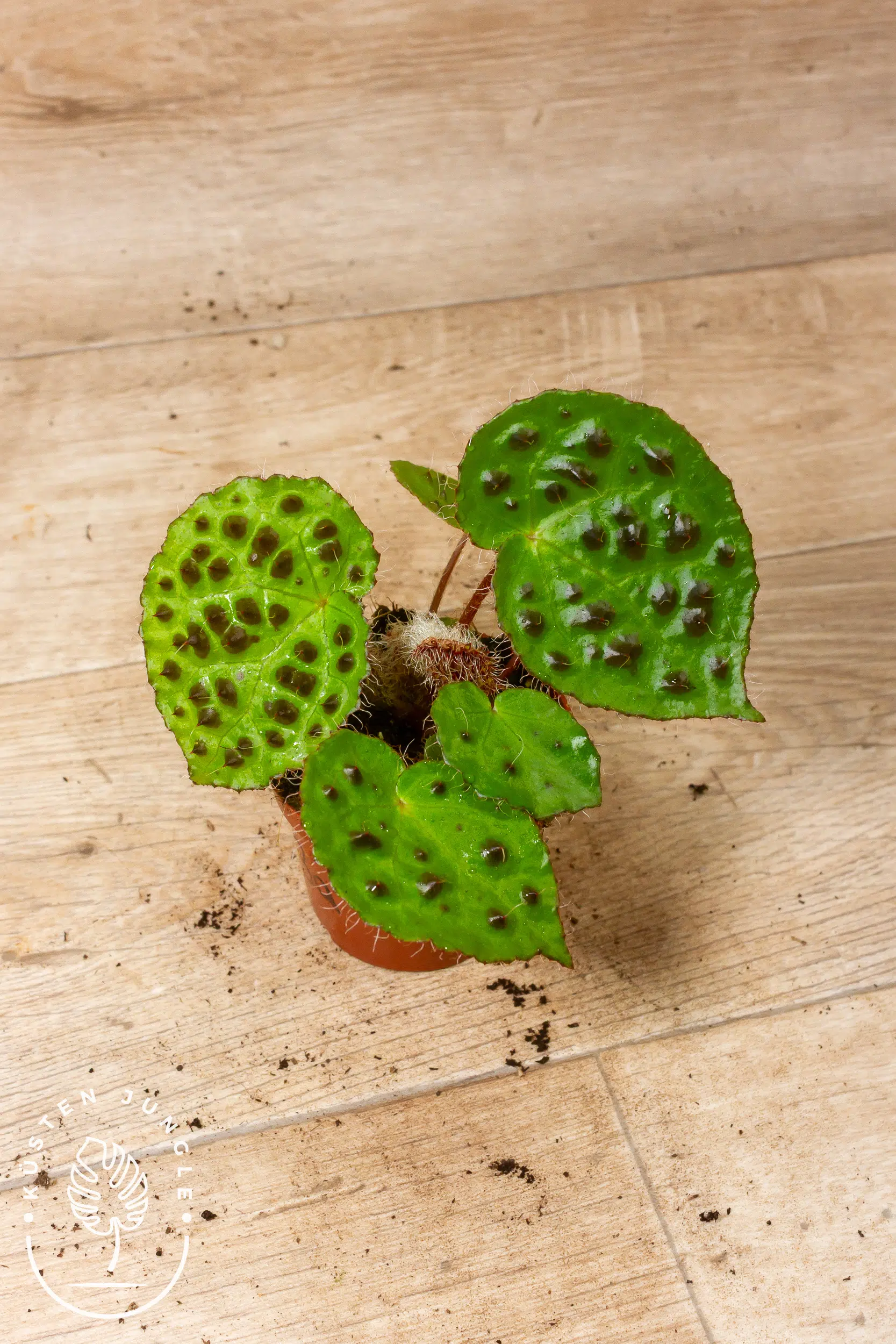
Begonia ferox grows creeping with a rhizome that spreads across the substrate over time instead of shooting upwards. The real highlight only appears with age: young leaves still appear quite inconspicuous and smooth, only later do the distinctive black, red-tipped elevations form, giving the plant its prehistoric look – presumably a camouflage to deter predators by appearing like a fungal or gall infestation. So, patience is worthwhile here. Sometimes this begonia is also sold under the trade name „Troll“.
Good to know
First scientifically described in 2013, Begonia ferox comes from a very small geographic area in the Longzhou County of China's Guangxi Province, near the border with Vietnam. It is strikingly similar to the similarly looking Begonia melanobullata from Vietnam, but differs, among other things, by shorter inflorescence stalks and a different leaf shape.
Like all begonias, this species also contains calcium oxalate and can cause nausea if ingested. It is also recommended to wear gloves when pruning or repotting, as the plant sap can cause irritation to sensitive skin.