
Begonia sp. „Julau“ Type 2 - Care
Location & Light
This begonia grows on the forest floor of Sarawak in the filtered partial shade of dense vegetation – a bright but shady to partially shaded spot without direct sun is therefore most suitable for it. The dark, almost black leaf surface with contrasting pink speckles absorbs sunlight very effectively, which is why direct sun quickly leads to burns. Despite targeted searching, there is no reliable source for a specific PAR or DLI value for this variety, which is why no numerical data is provided here.
Pour
Moist but never waterlogged – that's how this begonia likes it best. Water it as soon as the top layer of soil feels slightly dry, preferably directly onto the earth rather than over the leaves to avoid rot. Its fine roots are sensitive to waterlogging, so always remove excess water from the saucer.
Fertilize
A highly diluted liquid fertilizer about every 4 to 6 weeks during the growth phase is completely sufficient for this rather small-growing begonia; it is not a heavy feeder. General guidelines for the Begonia genus are a pH range of about 5.2 to 6.0 and an electrical conductivity of the irrigation water of roughly 0.5 to 1.3 mS/cm; follow the manufacturer's instructions for precise dosage. If the plant is only placed by the window in autumn and winter, it is fertilized less frequently or not at all due to the decreasing light; however, if it continues to grow year-round under sufficiently bright grow lights, fertilization can continue at the usual rhythm.
We consciously alternate between different fertilizers for our own plants – currently including COMPO COMPLETE, Foliage Focus, Liquid Gold Leaf, and Hesi TNT-Complex, supplemented with Hesi Root Complex, Hesi PowerZyme, and CalMag as needed.
Substrate
A loose, humus-rich mixture of potting soil, some perlite, and fine orchid bark closely resembles the natural forest floor where this begonia grows. Good drainage is especially important so that excess water can drain away quickly; however, a shallow dish made of terracotta shards or clay pebbles placed beneath the pot should be avoided, as it hinders root aeration rather than promotes it.
Humidity & Temperature
Like many Borneo begonias, this variety is actually quite demanding when it comes to humidity: It does not thrive long-term in normal indoor air humidity levels of 40 to 50 %; however, at around 70 % and higher, it appears vigorous with rich colors—a terrarium or greenhouse cabinet is actually the ideal environment for it. In terms of temperature, it thrives best between 21 and 27 °C; it does not tolerate temperatures below 18 °C or drafts well.
Growth & Form
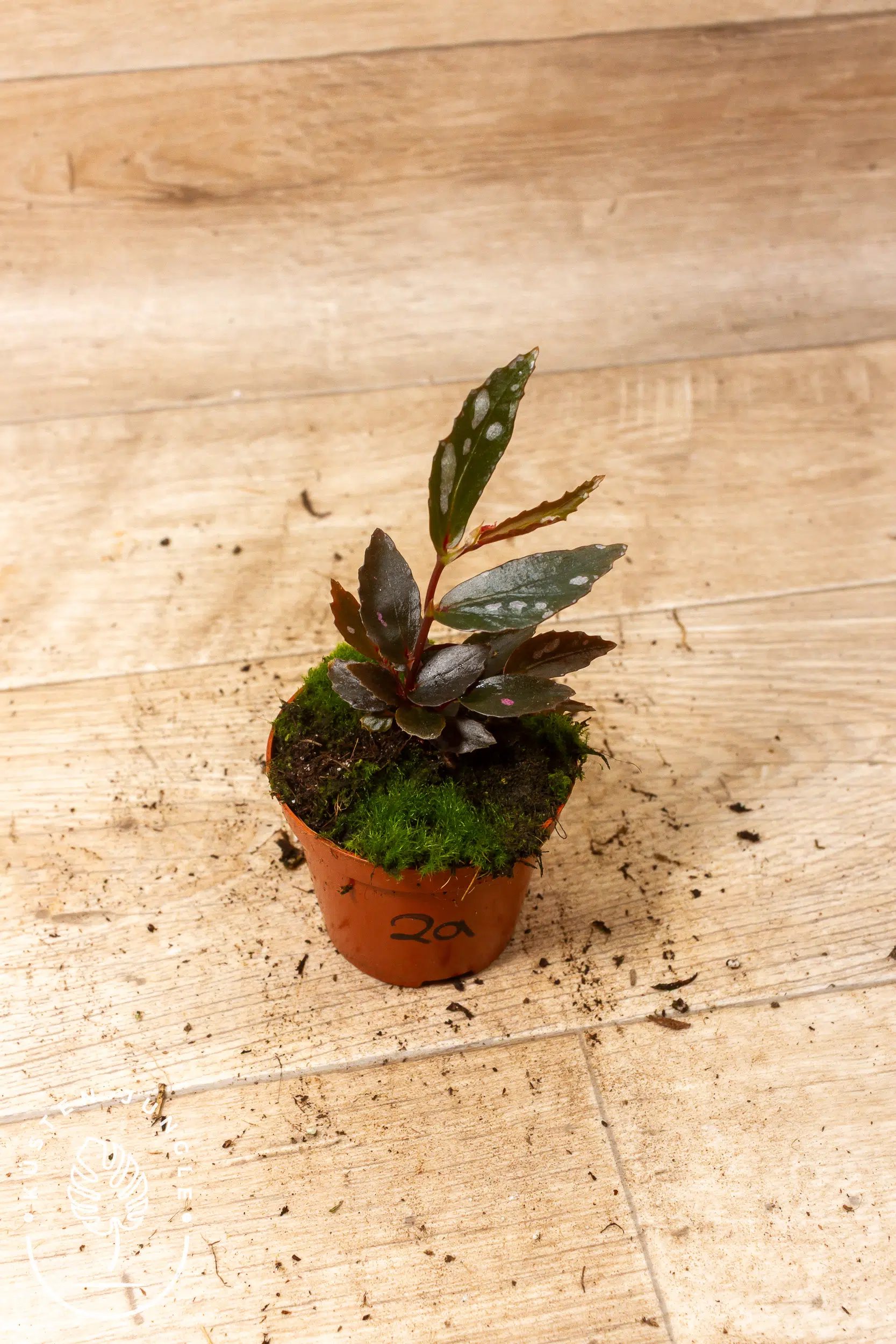
Characteristic of this variety are the rounded, shiny leaves in dark burgundy to almost black, on which strong pink speckles are clearly visible. The plant remains compact overall and grows more outward in width than upward in height, making it a good terrarium plant. A distinct dormancy phase is not documented; if growth noticeably slows, it is more worthwhile to check light and humidity than to wait for a supposed winter break.
Good to know
This begonia was collected in Julau, a small town in Sarawak on Borneo, and has not yet been fully described botanically. Among collectors, it circulates under several Julau forms with sequential type numbers – the Type 2 shown here differs from Type 1, already discussed on its own page, by its rounder rather than tapering leaves and its consistently dark burgundy-red to black ground color instead of a lighter one.
Begonias contain oxalates and are considered irritating to pets and children if ingested – best to place them out of reach. Regular inspection of the undersides of the leaves is also worthwhile, as mealybugs are among the more common problems with this genus.