
Epipremnum amplissimum Variegata - Care
Location & Light
Bright, indirect light best showcases the variegation of this variety, making a spot near an east or west window ideal. Happily adaptable, it also tolerates shadier corners, though it will grow slower there and the white portions of the leaves will appear paler. Direct midday sun should still be avoided, as it can scorch the leaves.
Pour
The top 3 to 5 cm of the substrate are allowed to dry out between waterings; this variety tolerates complete drying out significantly better than waterlogging. Drooping or limp leaves are a reliable sign of water shortage, whereas yellow leaves with dark spots are more likely a sign of too much moisture. Excess water in the saucer should always be poured off.
Fertilize
During the growth phase from spring to summer, a well-diluted liquid fertilizer about every 4 to 6 weeks is sufficient; fertilization is stopped in autumn and winter. Guidelines for the genus include a pH of around 5.5 to 6.5 and an electrical conductivity of the irrigation water of approximately 1.0 to 2.0 mS/cm. If the plant is only placed by the window in autumn and winter, no further fertilization is carried out due to the weaker light; however, with year-round bright plant lamp lighting, fertilization can be continued slightly longer in the normal rhythm.
We consciously alternate between different fertilizers for our own plants – currently including COMPO COMPLETE, Foliage Focus, Liquid Gold Leaf, and Hesi TNT-Complex, supplemented with Hesi Root Complex, Hesi PowerZyme, and CalMag as needed.
Substrate
A coarse, well-draining substrate of coco coir, perlite, and some bark provides the right balance between moisture retention and drainage. A pot with sufficient drainage holes is important; repotting is usually done about once a year or as soon as the root ball has doubled in size.
Humidity & Temperature
This variety is among the more tolerant aroids when it comes to humidity and also does well in drier living spaces. Higher humidity levels still promote lusher, stronger growth, and a humidifier or placing it with other plants can help. Regarding temperature, the ideal range is between 18 and 27 °C, and significant temperature fluctuations should be avoided.
Growth & Support
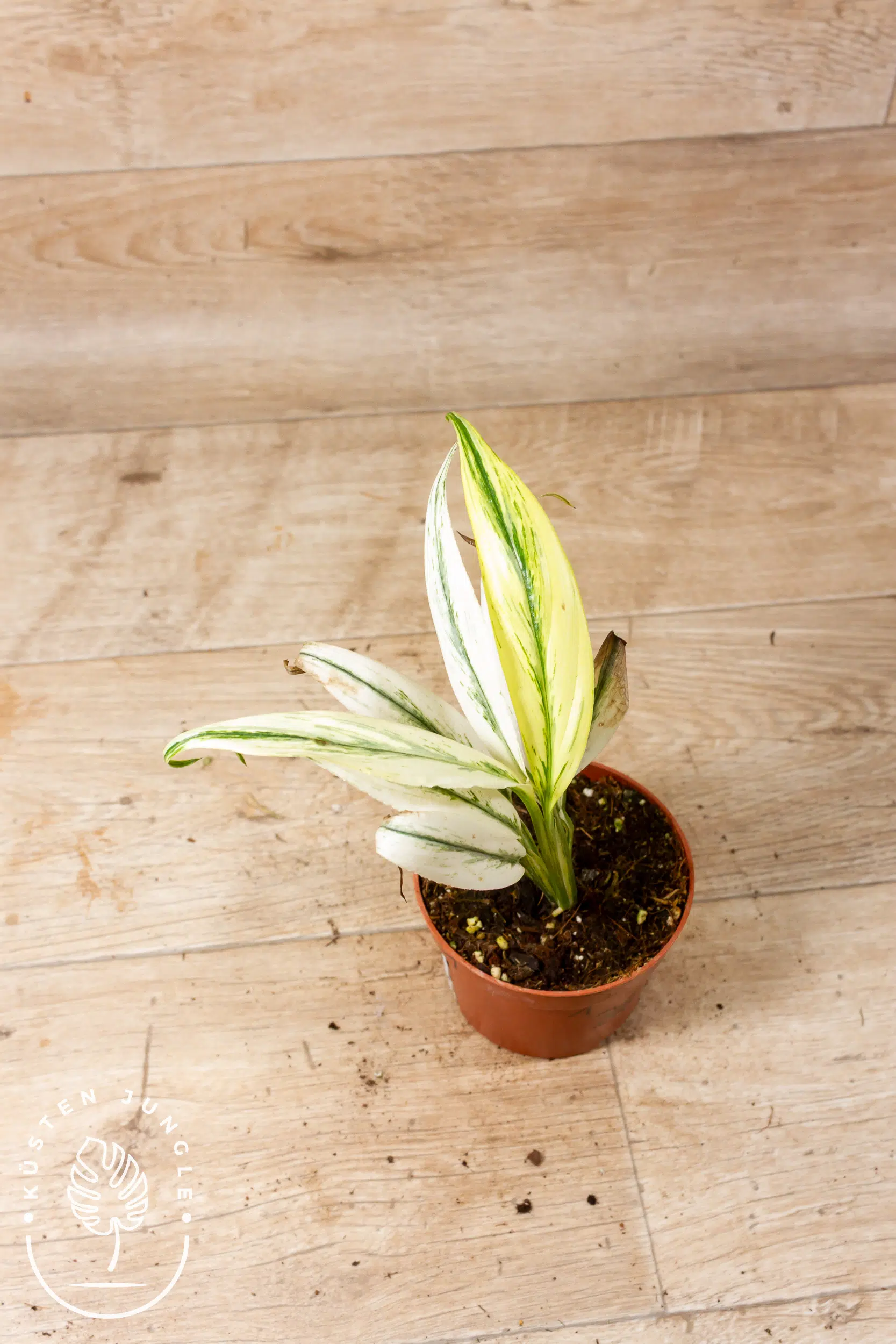
With its aerial roots, this variety climbs up tree trunks in nature and develops significantly larger, stronger leaves on a moss pole compared to when it's freely hanging. Young leaves appear narrow and change to an oblong-lanceolate shape as they grow; the green-lime colored striping of the young leaves brightens to a creamy white in many specimens as they mature. With solely window cultivation in autumn and winter, growth noticeably slows due to weaker light; however, with year-round bright plant lamp illumination, growth remains largely uniform.
Good to know
Epipremnum amplissimum is a distinct species and originates from the region of New Guinea through Vanuatu to northern Australia, where it grows epiphytically on tree trunks; a botanical synonym is Rhaphidophora amplissima. Unlike the highly dissected, fenestrated leaves of some related species, the leaf shape of this species remains relatively simple and undivided even when climbing.
Like all aroids, this Epipremnum presumably contains calcium oxalate crystals and should therefore be kept out of reach of pets and children as a precaution.