
Ficus lyrata ‚Variegata‘ - Care
Location & Light
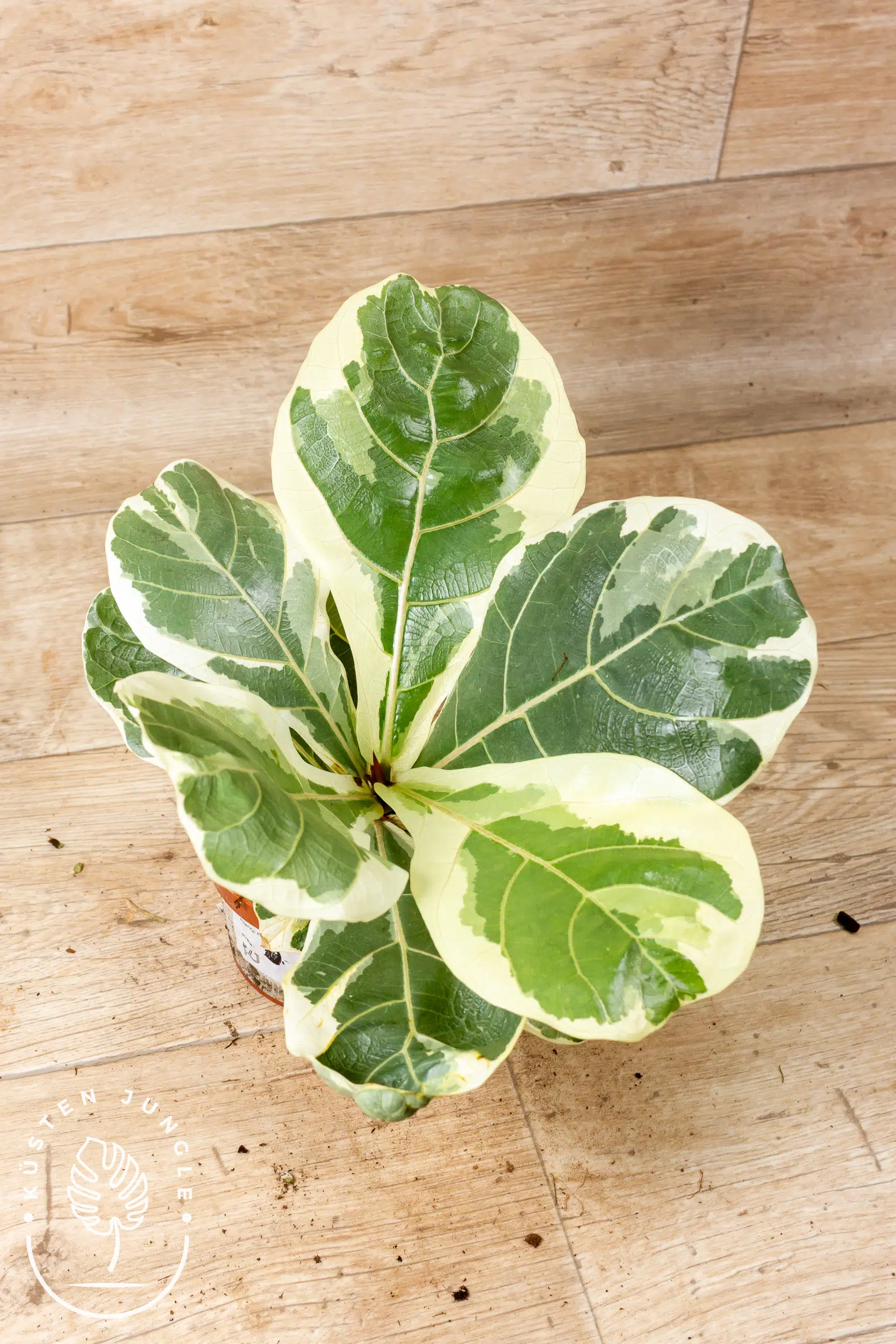
A bright to partial shade location will bring out the creamy white marbling of this variety most strongly. It definitely needs a bit more light than a non-variegated fiddle-leaf fig so that the pattern doesn't fade. However, direct, prolonged sunlight will lead to leaf scorching. Important: Once you've found the right spot, the plant should not be rotated or moved if possible, as it tends to react to changing light conditions by dropping leaves.
Pour
Water again only when the top layer of the substrate feels dry. The goal is for it to be freshly to moderately moist, neither drying out nor waterlogged. Once a week is usually sufficient during the growth phase, and significantly less often in winter. A few hours of water in the saucer are not a problem, but permanent waterlogging leads to root rot and should therefore be avoided.
Fertilize
In the first year after purchase or repotting, the plant does not need additional fertilizer, as commercially available substrates are usually already pre-fertilized. After that, a well-diluted liquid fertilizer once a month is sufficient during the growth phase from spring to autumn. The pH value of approximately 6.0 to 6.5 and an electrical conductivity of the irrigation water of roughly 1.0 to 2.0 mS/cm are considered guidelines for this genus. If the plant is only placed by the window in autumn and winter, no further fertilization is done due to the weaker light; however, with year-round bright plant lamp lighting, fertilization can continue at the usual rhythm.
We consciously alternate between different fertilizers for our own plants – currently including COMPO COMPLETE, Foliage Focus, Liquid Gold Leaf, and Hesi TNT-Complex, supplemented with Hesi Root Complex, Hesi PowerZyme, and CalMag as needed.
Substrate
A humus-rich, well-draining potting mix, with a bit of sand or perlite added for extra drainage if needed, is best for this plant. Repotting is infrequent, usually every two to three years or once the roots start growing out of the drainage holes. For larger, older specimens, it's often sufficient to simply replace the top few inches of soil in the spring.
Humidity & Temperature
Unlike many other tropical houseplants, this fiddle-leaf fig is surprisingly tolerant of normal, even dry, indoor air. Special measures to increase humidity are usually not necessary. Therefore, you can safely skip misting – the effect on humidity is only short-lived anyway, and moisture that collects in the leaf axils can even promote rot. The temperature should not permanently drop below about 15 to 18 °C, but the plant tolerates drafts quite well.
Growth & Form
With its large, leathery leaves and distinctive veining, this fiddle-leaf fig grows into a stately, tree-like plant over the years, easily reaching several meters in height. It can be grown as a single trunk with a pruned crown or as a bushy multi-stem form. If you want a straight trunk, support the plant early and remove lower branches. With window-only placement in autumn and winter, growth noticeably slows due to weaker light; conversely, with year-round bright plant lamp illumination, growth remains largely consistent.
Good to know
Ficus lyrata originates from the tropical rainforests of West and Central Africa, such as Sierra Leone, Nigeria, Ghana, and Cameroon, where it grows several meters tall in the wild. Unlike the previously described Araceae family, it belongs to the mulberry family (Moraceae) and does not contain calcium oxalate crystals, but it does have a milky sap that can cause irritation to sensitive skin and in the mouth area.
Therefore, wearing gloves is recommended for larger pruning jobs to avoid direct contact with the milky sap; additionally, consumption can lead to mild gastrointestinal upset, so the plant should be kept out of reach of pets and children.