
Phyllanthus urinaria ‚Pink Variegata‘ - Care
Location & Light
Bright, indirect light best showcases the pink-creamy variegation of this delicate plant, while too much direct sun can quickly scorch the tender leaf areas. A spot by an east or west window usually works well, with gentle morning sun generally tolerated. If the plant is placed in too dark a location, its growth will become noticeably more hesitant, and the coloring will be less pronounced.
Pour
The fine roots are sensitive to excessive moisture, so the top layer of the substrate should be allowed to dry out slightly between waterings before watering again. During the growing season, the plant needs water a bit more regularly than in winter when it grows more slowly. Waterlogging in the cachepot should generally be avoided, as it can quickly lead to root rot.
Fertilize
During the growth phase from spring to summer, a well-diluted liquid fertilizer about once a month is sufficient; in winter, fertilization is discontinued or significantly reduced. General guidelines for the genus are a pH value of approximately 5.5 to 7.0 and an electrical conductivity of the irrigation water of roughly 1.0 to 1.5 mS/cm. If the plant is only placed by the window in autumn and winter, less frequent or no fertilization is done due to the weaker light; however, with year-round bright plant lamp lighting, fertilization can continue at the usual rhythm.
We consciously alternate between different fertilizers for our own plants – currently including COMPO COMPLETE, Foliage Focus, Liquid Gold Leaf, and Hesi TNT-Complex, supplemented with Hesi Root Complex, Hesi PowerZyme, and CalMag as needed.
Substrate
A well-draining substrate made of coco coir, perlite, and some pine bark or coco chunks provides the necessary aeration for the fine roots and prevents waterlogging. A pot with reliable drainage is particularly important for this plant, as the roots tolerate wet feet poorly.
Humidity & Temperature
This plant generally does well in normal indoor air conditions, but at levels of 50 % and higher, it exhibits significantly more vigorous and denser growth. Placing it near other plants or an air humidifier can also help, but it’s not essential. The ideal temperature range is between 18 and 28 °C; temperatures should not drop below 15 °C for extended periods.
Growth & Form
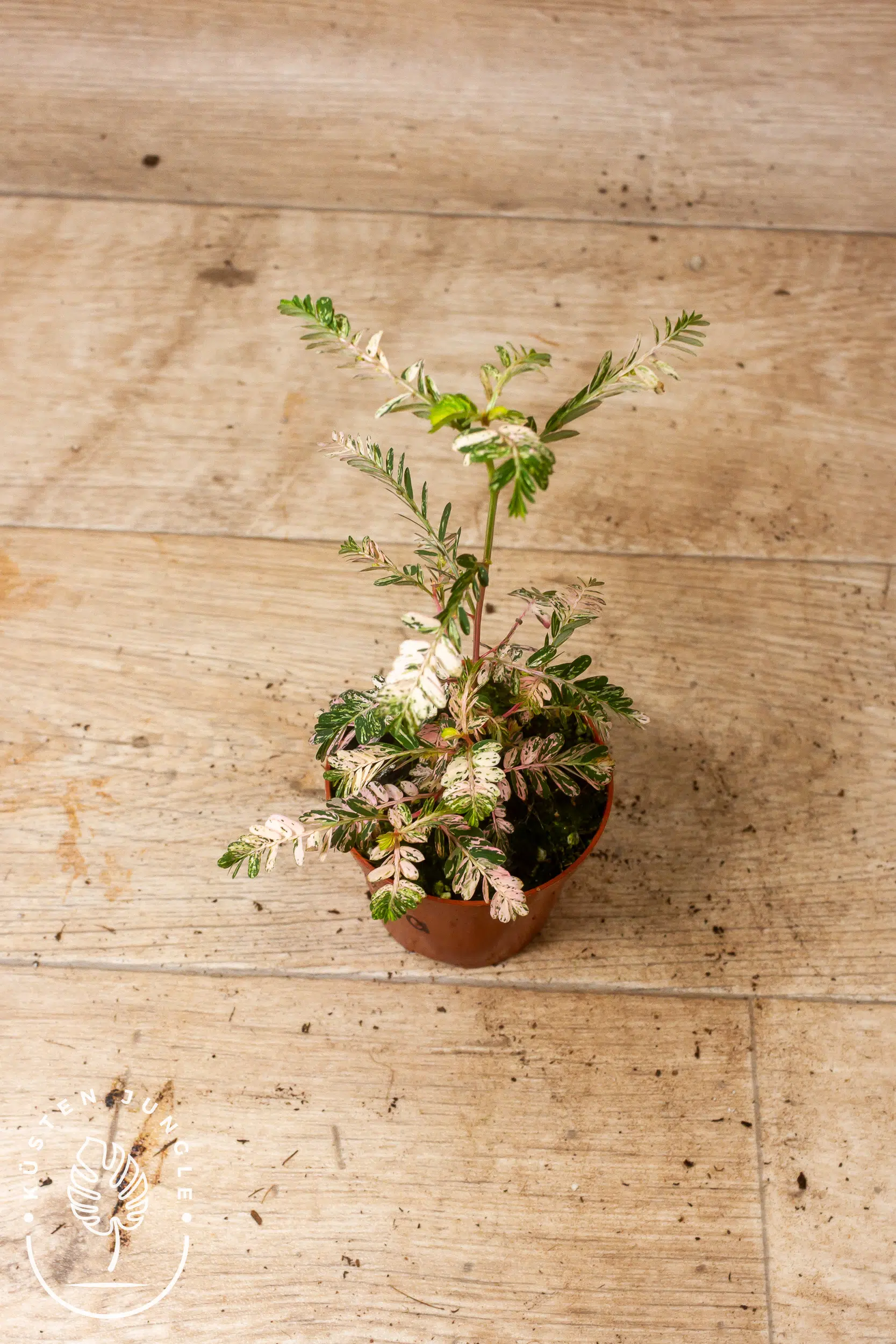
With its loose, slightly arching growth habit and small, symmetrically arranged leaflets, this plant appears delicate and airy, but under the right conditions, it is surprisingly vigorous and quickly forms a dense canopy of leaves. Like the wild form, the leaflets fold up in the evening and open again in the morning – a natural, nyctinastic behavior similar to mimosa, not a sign of drought stress. In cultivation, it grows as a short-lived subshrub; occasional propagation by cuttings keeps the stock permanently fresh.
Good to know
This ‚Pink Variegata‘ is not to be confused with the white variegated ‚Albo Variegata‘ – same species, but a markedly different leaf color. Unlike the previously described aroids in the rulebook, Phyllanthus urinaria belongs to the Phyllanthaceae family and therefore does not contain calcium oxalate crystals, making it largely harmless to pets and children.