
Spathiphyllum ‚Blue Ice‘ - Care
Location & Light
Medium to bright, indirect light best highlights the cool, silvery-green leaf color of this variety. Direct sun quickly scorches the leaves. A spot a little further from the window will still be tolerated, though growth and flowering will be somewhat less vigorous.
Pour
The substrate should be kept evenly moist, without the roots completely drying out or standing in water permanently. Drooping leaves are a reliable, clearly visible sign of water shortage in this plant and usually recover quickly after watering – therefore, regular checking replaces a rigid watering schedule. Excess water in the saucer should still be poured off to prevent root rot.
Fertilize
During the growth and flowering phases, this plant benefits from a well-diluted liquid fertilizer every 2 to 3 weeks. In fall and winter, a significantly reduced amount or no fertilizer at all is sufficient. The Peace Lily is considered quite sensitive to salt, so it's better to dose sparingly and always apply the fertilizer to already moist soil to ensure even distribution. A rough guideline for the conductivity of the irrigation water is 1.0 to 1.5 mS/cm, preferably on the lower end. Otherwise, overly high concentrations will quickly manifest as brown spots on the leaves.
Recommended value for Spathiphyllum (multiple confirmations): pH 5.0–6.0
We consciously alternate between different fertilizers for our own plants – currently including COMPO COMPLETE, Foliage Focus, Liquid Gold Leaf, and Hesi TNT-Complex, supplemented with Hesi Root Complex, Hesi PowerZyme, and CalMag as needed.
Substrate
A loamy, well-draining substrate with some perlite or expanded clay for root aeration is suitable. Simple, inexpensive potting soil without further additives often does not buffer nutrients and moisture reliably enough, so a higher-quality mix is worthwhile. Repotting is usually done once a year in spring until the final size typical for this compact variety is reached.
Humidity & Temperature
This variety tolerates normal indoor air well, but visibly appreciates higher humidity and rewards it with juicier growth. A humidifier nearby or occasional misting of the leaves will also help here. For temperature, the comfort zone is between 18 and 27 °C; below 15 °C, flower formation is noticeably delayed, and a spot directly above a heater should be avoided due to the dry air there.
Growth & Form
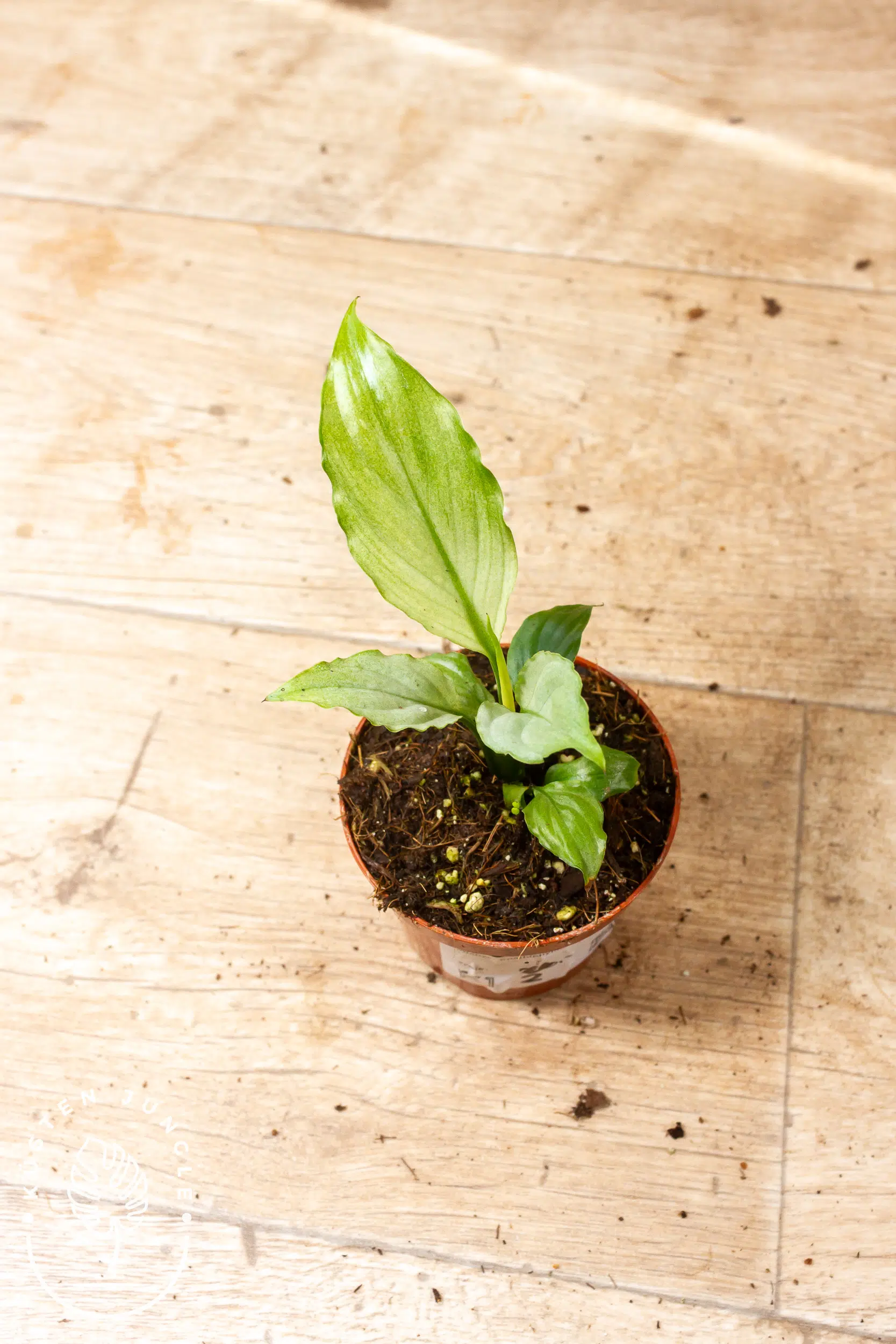
‚Blue Ice‘ remains comparatively compact, making it suitable for small to medium-sized pots. The young leaves are particularly bright in a frosty mint color, while older leaves darken to a cool, somewhat more subdued green – a fluid color gradient that gives the plant its „ice“ name. Under good conditions, the typical white flowers of the genus appear. Immediately after purchase, this variety is more sensitive to changes in transport, location, and climate than other Peace Lilies, so a short acclimatization period with drooping or somewhat limp leaves is therefore normal. When kept solely by a window in autumn and winter, growth slows noticeably due to weaker light and flowering is less likely. In contrast, under year-round bright plant lamp lighting, it is more likely to continue blooming even during the darker seasons.
Good to know
Spathiphyllum belongs to the Araceae family and originally comes from tropical America. ‚Blue Ice‘ differs from classic, deep green Peace Lily varieties with its cool, silvery-bluish leaf coloration and is considered robust and easy to care for despite its delicate appearance.
Like all arums, this peace lily also contains calcium oxalate crystals and is irritating to pets and children if ingested – it's best to place it out of reach.